
Fireside Talk:
What’s that Cattle Herd Doing in a National Park?
Posted November 6, 2016
(Recorded in Capitol Reef National Park, October 31, 2016)
J. William T. Youngs
(Note: perversely some of the images in this post do not stay posted. I have spent most of my Sunday wrestling with this problem, writing this post and inserting and re-inserting the images. I hope tomorrow, Monday, to get some help on campus for posting the images, but in the mean time some of them and all of the film clips appear to be working, and I want to get this to you now….)
Part I: A Park-Appropriate Kingdom of Rocks and Animals
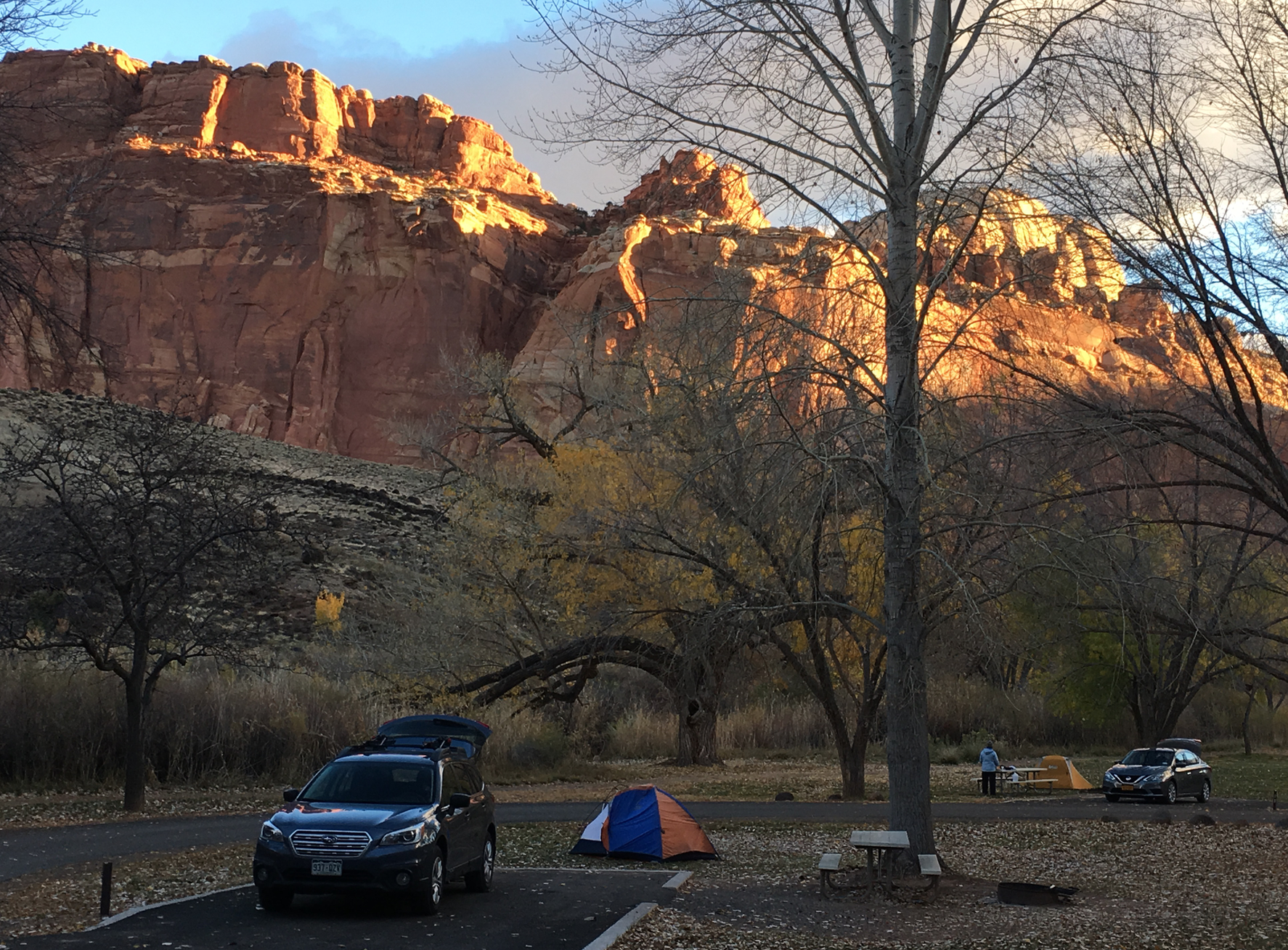
‘Twas the beginning of a beautiful morning at Capitol Reef National Park. All the rocks and creatures were behaving as befits the nobility of a national park. The sun shone brightly on the rocks over the campground:
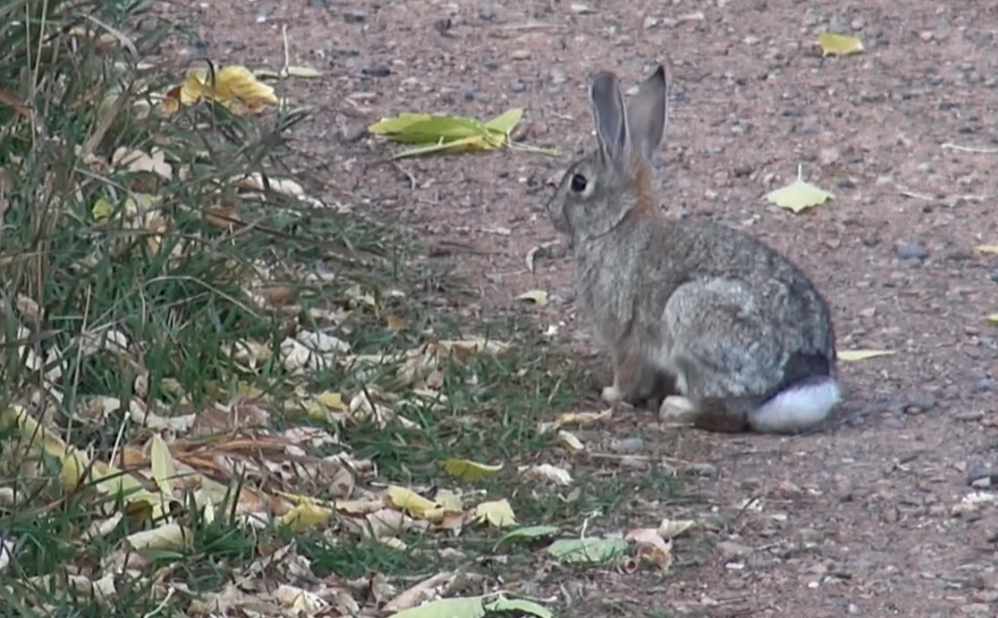
A bunny hopped in front of me down a trail. And why not? He belonged there as much as I did — maybe more!
Then there were the deer: they walked past the camp ground as if they owned the place. And who knows, maybe they did. Certainly on this Halloween morning they did.
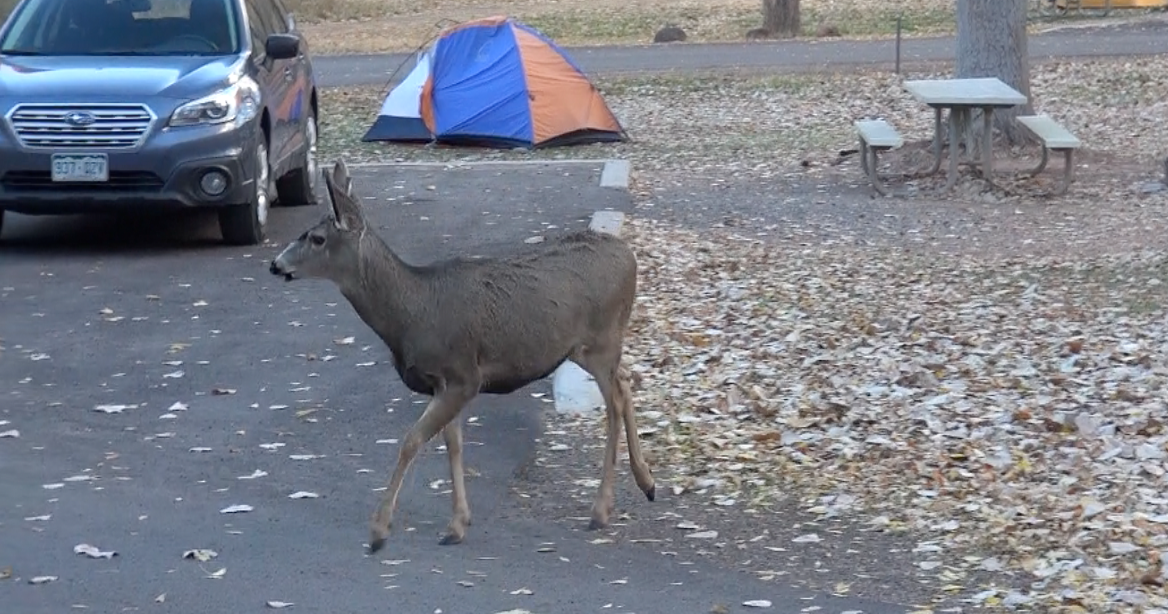
Let’s have a look at those deer in motion, enjoying the national park:
And did you notice those oaks?! Surely they belong here too — although, it being Halloween, perhaps they appear only once per year. Check this film clip for a fuller view.
Later in the morning my friends and I decided to take a walk down a narrow road into one of the deep canyon gorges. I went ahead with their dog, Cosmo, who also looked as if he “belonged” in the park — although I must confess I was transgressing one of the park rules on dogs: canines are allowed, but not on park trails. This was OK since we were on a road. But they must be on a leash at all times.
Whoops!
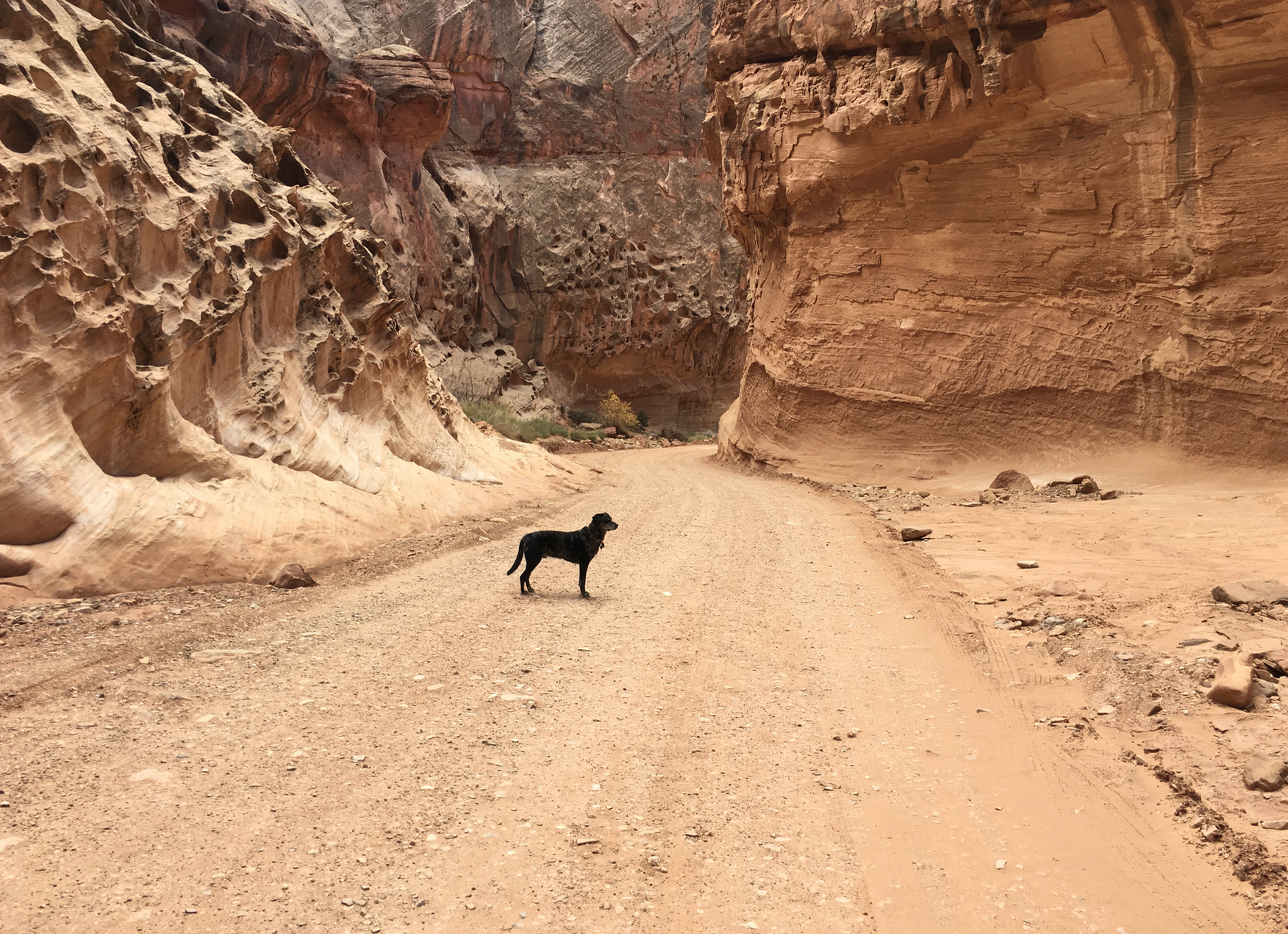
All in all — with the exception of one well-meaning dog and his somewhat absent-minded minder, who was thinking about his next National Parks lesson plan — Capitol Reef was in fine form Halloween morning, 2016?
But wait one minute!
Part II: The Bovine Invaders
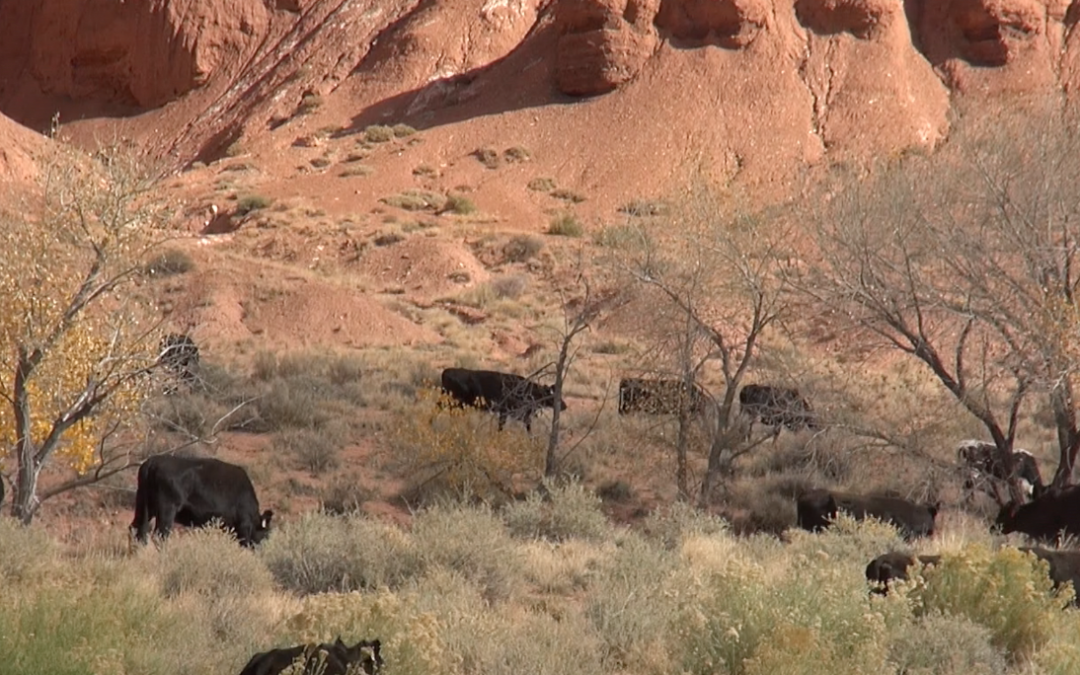
Do you remember the story of the park-hating ranchers in Jackson Hole who drove their cattle through Grand Teton National Park in defiance of new regulations? They were kind of an old-fashioned version of the Bundy Bunch who recently occupied the park headquarters at Malheur National Wildlife Refuge.) Well look at what greeted us on the park grounds near the Visitor Information station just a few minutes after our walk:
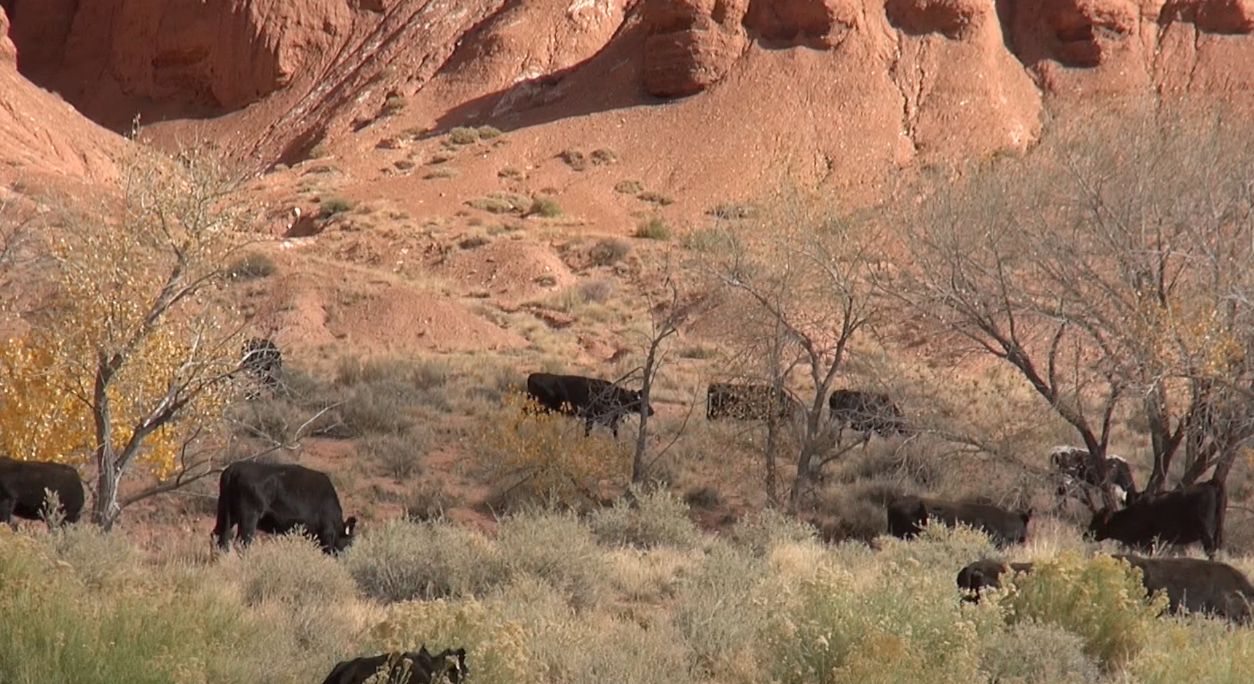
Those, my friends, are neither deer nor moose nor antelope. They are c-o-w-s!
In our national park!
Do you remember what John Muir had to say about another form of domestic animal in a park, Yosemite. They were sheep, but because of the way they ravaged wild flowers and other park attractions, he dubbed them “hooved locusts.”
Do you remember what the army patrolling Yosemite did when they found sheep herders and their flocks trespassing in the park?
“Out you go, Mister. Head west until you leave the park. And by the way, if you want to recover your sheep, we’ll be herding them to the east exit. You can walk around the park and pick them up there!”
We settled that one long ago, and so what were those cows doing in Capitol Reef National Park.
Let’s look further: these are some pictures I took of the cattle, several cowboys, and some random snippets of conversation.
It turns out that the cattle were in the middle of about a 20 mile drive across the park. This was their noon break. After visiting for a spell, I crossed the street to the visitor’s center and did some visiting there. Later on we drove on west crossing the herd again along the main road across the park:
So it had not been my imagination. I really had seen a herd of cattle in Capitol Reef National Park. So what were they doing there, and what is the lesson for History 498? Truth be told, I had already known that a herd of cattle would be crossing Capitol Reef National Park on October 31. By chance the day before I had run into a man who drove one of the support cars. He explained that when the the land became a national park a local rancher was guaranteed the right to drive his cattle to winter pasture on the other side of the park every year on October 31 as long as he lived–and as long as his three sons lived. Their right was “grandfathered” in for what may prove to be several decades more. The father died only recently in his 90s and his sons, in their 60s, looked as if they too might live long lives.
The cattle would amble down Highway 12, where we passed them, to a point where they would swim the Fremont River on the way to that winter range. Interestingly, some folks said the range was on park land and others said no, it was not.
In any event, a cattle drive on national park land is something you should not expect to encounter very often — if at all. The fact is that I “lucked out” and saw the drive on the one day in the year when it occurs — and thus gathered material for this little talk.
Here is the lesson I see in the event: the parks have a written-in-stone mission to preserve a natural environment. In no way are cattle part of that picture. But sometimes for one reason or another that “stone” is more like a flexible board: it has to bend. We have seen that bending in many ways during the course of our course. We have seen it in road-building and car-driving in the parks; in the admission of vast crowds of tourists; in non-natural entertainment (for a while at least) like bear-feeding in Yellowstone and the firefall in Yosemite. We have seen it is the acceptance of man-made artifacts in the parks, like cabins in the Smokey Mountains or that orchard in Capitol Reef.
The bending is also there in the compromises the government has made sometimes to move private lands into the parks. In the Grand Tetons, for examples, some ranchers were allowed to remain on park land in exchange for agreeing that the park could acquire their land after their deaths or the death of their children.
That cattle drive I’ve tried to share with you is another example of that bending. Someday cattle will no longer be driven through the park. But I am glad I was there to see it, and to share it with students in History 452.