
‘Unbelievable’ idiot tourist at Yellowstone National Park sparks outrage online: ‘This is highly disrespectful’

Whether it’s a symptom of the times or something that’s now being exposed by the ubiquity of social media, it’s disturbing and frustrating all the same.
Another incident of bad behavior at a national park sparked outrage recently on Instagram, as a woman stood within reach of a prone bison on the side of a road and a few others swarmed mere feet away.
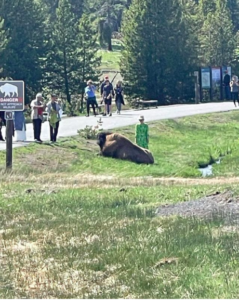
The two photos — the first of which captured a nearby sign reading “DANGER: DO NOT APPROACH WILDLIFE” — credited another user:
“She was probably a foot or 2 [from the animal and] was about to pet him and a ranger started yelling at her from the road! This was across from old faithful gas station and someone has just been charged by the same animal,” the user who took the pictures wrote for the caption. “ambulance and rangers were just across the street from this disaster in waiting!”
There are so many people who endanger themselves and others with this kind of bad behavior that there’s an Instagram page dedicated to exposing them: Tourons of Yellowstone. The portmanteau is a play on the words “tourists” and “morons.”
“The sign saying do not approach wildlife. This is not only irresponsible, this is highly disrespectful,” one user commented. “There should be fines for careless behavior like this.”
Another said: “Unbelievable. Lifetime ban of all national parks. Need to enforce $10,000 fine and/or 6 months in jail for failing to follow the park rules. Period.”
Like all wildlife, bison can be unpredictable. They can charge at a moment’s notice, and sometimes even a car doesn’t provide enough protection.
Visitors are advised to stay at least 25 yards away. The animals can become agitated more quickly during their mating season, from mid-July to mid-August.
They run three times faster than humans and have injured more people than any other animal at Yellowstone.
“Approaching bison threatens them,” according to the National Park Service, “and they may respond by bluff charging, head bobbing, pawing, bellowing, or snorting. These are warning signs that you are too close and that a charge is imminent.”
“Do not stand your ground. Immediately walk or run away from the animal. Spray bear spray as you are moving away if the animal follows you.”
The hazards of Yellowstone are well documented, from such dangerous wildlife to boiling hot springs, which have injured or killed more people than any other natural feature in the park. Visitors should never approach animals, stay on boardwalks at all times, and refrain from feeding the fauna.
Sometimes animal sightings can create traffic jams, and guests should stay with their cars in those cases.
Yellowstone, which is mostly in Wyoming but also is in parts of Montana and Idaho, is the only place in the United States where bison have lived since prehistoric times, according to the Department of the Interior. The park’s population of some 5,450 bison in 2021 marks the largest on public land.
There are about 10,000 bison on public lands across 17 herds in 12 states, accounting for one-third of the continent’s wild population.
The mammals, the largest in North America, can weigh up to 2,000 pounds and stand 6 feet tall.
All the more reason to let them be.
“I honestly feel awful the Park Rangers have to deal with this,” one user wrote. “I thought keeping kindergartners in line was tough. But TOURONS.”
Another noted: “These people are going to mess the Yellowstone experience up for those of us that have half a brain and common sense!!”
Join our free newsletter for cool news and cool tips that make it easy to help yourself while helping the planet.
National Parks in the News
— “Witnesses from the National Park Service and other organizations testified on overcrowding at national parks following the end of COVID-19 closures. The hearing took place before the House Natural Resources Subcommittee on Oversight and Investigations. In the first portion Jeff Bradybaugh, superintendent of Zion National Park, answered members’ questions about the issue, as well as funding and visitor-experience. In the second portion, nonprofit leaders and a university professor elaborated on overcrowding at other parks, such as Yosemite and Yellowstone, and factors contributing to the problem.” Read the Article
— This morning (September 26, 2014) I saw this article: “America’s newest national park is twice the size of Texas and underwater” — It’s official — that massively and unprecedentedly HUGE marine reserve Obama announced back in June is now a reality. The announcement came on Thursday morning that 470,000 square miles of ocean around a couple of remote Pacific islands will be formally set aside as a national marine monument — aptly named the Pacific Remote Islands National Marine Monument….” Read the article
— Factoid: even at 470,000 square miles this is not the world’s largest land-based national park, because it is mainly water and the sea bed. The honor for national park with the largest land base goes to Northeast Greenland National Park at 375,000 square miles. Read the article
A 150,000-Bird Orchestra in the Sky
Note: this article provides one example of the sometimes awkward collision of urban life and wild nature.
A huge flock of purple martins is using Nashville as a staging ground for the fall migration — and bringing music back to the city’s shuttered symphony center.
New York Times, Sept. 7, 2020, 5:00 a.m. ET
Purple martins in roosting in trees in Nashville, Tenn.William DeShazer for The New York Times
NASHVILLE — At first they circle high in the evening sky. But as night descends, they, too, begin to descend, bird by bird, one at a time, and then all in a rush: 150,000 purple martins swirling together, each bird calling to the others in the failing light as they sweep past the tops of buildings in the heart of downtown Nashville. To anyone watching from the ground, they look like one great airborne beast, one unmistakable, singular mind.
Their music grows louder and louder as the circles tighten and the birds swing lower and lower, settling in the branches of sidewalk trees, or swerving to take off again as new waves of birds dip down. They circle the building and return. They lift off, circle, reverse, settle, lift off again. Again and again and again, until finally it is dark. Their chittering voices fall silent. Their rustling wings fall still.
It is not like Hitchcock: Watching these birds is nothing at all like watching crows and sea gulls and sparrows attack the characters in “The Birds,” Alfred Hitchcock’s classic horror film. The purple martins that have been gathering here the past few weeks are merely doing what purple martins always do this time of year: flocking together to fatten up on insects before making the long flight to South America, where they will spend the winter.
That’s not to say the birds aren’t causing problems. The place where they have chosen to roost this time is Nashville’s Schermerhorn Symphony Center, which was already having a terrible year. With all scheduled programming canceled or postponed by the pandemic and so much of the symphony budget based on ticket sales, the organization had no choice but to furlough all the musicians and most of the staff and hope for better days. What the Nashville Symphony got instead was a plaza full of bird droppings and elm trees so burdened by the weight of 150,000 birds alighting in them night after night that whole limbs are now bent and hanging limp.
Nashville residents have been coming out in the evenings to watch the purple martins.William DeShazer for The New York Times
The folks at the Schermerhorn at first assumed the birds roosting in their trees were starlings. Downtown Nashville is home to a large number of European starlings that live here year-round, and they have been a nuisance in years past. It’s easy to mistake a flock of purple martins for a flock of starlings, especially when actual starlings join the martin flock from time to time.
Starlings are an invasive species, introduced during the early 1890s by Shakespeare enthusiasts determined to bring to the United States every bird ever mentioned in Shakespeare. All 200 million starlings now living in North America are descended from a few dozen birds unwisely released into Central Park during the late 19th century. Thanks to the Migratory Bird Treaty Act, it is against the law to kill native songbirds. It is perfectly legal to kill starlings.
The transcendently beautiful Schermerhorn is built of limestone, which is highly porous. “The sheer amount of bird poop was causing a massive amount of damage,” my old friend Jonathan Marx, the interim chief operating officer of the Nashville Symphony, said when I called him to ask about the purple martins. “But we never had any intention of killing the birds. We just wanted them to move on.” The plan was to disperse them by fogging the trees with grapeseed oil.
Purple martins have been roosting in the Nashville area for years — at least since 1996, according to Melinda Welton, the conservation policy co-chair of the Tennessee Ornithological Society — though always before in much smaller numbers. Among birders, word quickly got around that the purple martins had settled in at the Schermerhorn this year, and in far, far greater numbers than ever before. “It’s a pretty remarkable roost — definitely one of the larger ones in the country,” Joe Siegrist, the president and chief executive of the Purple Martin Conservation Association, said on the phone last week.Which is why Kim Bailey, Kim Matthews, John Noel, Anne Paine, Ms. Welton and Mary Glynn Williamson went into action as soon as Mr. Noel noticed a pest control truck on the symphony plaza. It was, as Mr. Marx put it, “a collision of people who are taking care of their property with people who are staring in awe and wonder at the birds.”
Purple martins are already in trouble from virtually every angle imaginable. Climate change has intensified hurricane season, making the fall migration even more perilous. Deforestation has destroyed the birds’ natural nesting sites, and aggressive nonnative species like starlings and house sparrows have claimed most of those that remain. Like other swallows, purple martins are insectivores, but pesticides have made food scarce. One reason the birds chose Nashville as their migration staging ground may be its proximity to the insect-rich Cumberland River.
That night, while Ms. Bailey, who works as a staff naturalist at the Warner Parks Nature Center, explained to the exterminators that purple martins are a federally protected species, others in the group starting calling and texting and messaging everyone they could think of who might be able to help: News Channel 5, the mayor’s office, the Tennessee Wildlife Resources Agency, and local conservation nonprofits like the Tennessee Wildlife Federation, the Nature Conservancy in Tennessee, and the Nashville Wildlife Conservation Center.
Purple martins have been roosting in the Nashville area for years, though always before in much smaller numbers. William DeShazer for The New York Times
Those folks reached others, who in turn contacted others still. With phones ringing and emails flying and social media on fire, the exterminators hastily decamped. The group stayed put, Ms. Bailey told me in an email, until they received assurances from a T.W.R.A. officer that he had contacted the pest control company and the truck would not be returning that night.
And now, like a flock of purple martins, this story veers in an unexpected direction. A tale of conflict becomes instead the story of human beings who listened to one another and then came up with a plan that benefits everyone involved, and the birds most of all.
Mr. Marx heard from a number of conservation groups that evening and others the following day. Each time he explained that the symphony staff had no idea they were hosting purple martins and, now that they knew the truth, would never harm or harass the birds. But he also pointed out that the flock had already caused significant property damage: The cost of power-washing the front of the building alone is at least $10,000, and that’s not even addressing the rest of the building or the damage to the trees.
“As soon as we heard that, we started trying to think of ways in which we could work together,” Terry Cook, the state director for the Nature Conservancy in Tennessee, told me. “One, we wanted to mitigate the current impact of the roost, but, two, we wanted to think about long-term opportunities to either make the site less preferable to purple martins in future years or to embrace this as a unique Nashville event.”
Within hours, the Tennessee Wildlife Federation and the Nature Conservancy in Tennessee had joined forces to start a fund-raising campaign to help with cleanup costs. “In the conservation community, we felt like we needed to rally around this problem so the symphony wouldn’t have to carry this burden alone,” said the Tennessee Wildlife Federation’s Kendall McCarter, who hosts a nesting colony of purple martins in his own yard every year. “Especially right now, when they’re in a very difficult place because of Covid.”
The initial campaign to pay for power washing the Schermerhorn’s facade was fully funded within hours, but the appeal is ongoing, and any extra money it raises will be used to treat damage to the trees, to replace trees that can’t be saved, and to help with costs that arise during future purple martin migrations. Because the birds, which seem to prefer well-lighted roosts, will most likely be back.
In one way of looking at it, this rescue operation mimics the long relationship between human beings and purple martins themselves: Even as we are responsible for the birds’ troubles, we are also responsible for their survival. The population east of the Rocky Mountains, where 98 percent of all purple martins live, “is completely reliant on people putting up bird houses for them to reproduce in,” said Mr. Siegrist. “If people didn’t do that, the bird would go extinct in the majority of its range. Each one of those birds putting on that spectacular display in downtown Nashville exists because people cared enough to put up a bird house. Each one of those birds came from somebody’s backyard.”
“We’re so thankful to have community partners who are willing to help us deal with this completely unexpected situation,” said Mr. Marx, “because we need to be putting our focus on the fund-raising that’s going to allow us to bring our musicians back to work. This is a time when so many people are under so many forms of duress, but one thing we know is that music is one of those things that brings people together.”
Until then, this collaboration between naturalists and the symphony is, for everyone involved, a happy ending at a time when people are desperate for happy endings. “I’m so excited about how it’s been handled there in Nashville,” Mr. Siegrist said. “I think it can be a blueprint for other communities.”
I find myself dreaming of a time when the musicians of the Nashville Symphony are back in that beautiful space, perhaps even playing a sunset concert, the doors of the Schermerhorn thrown wide to the music of purple martins swooping down from the sky. What a glorious sound that would be, after this year of silence and fear. What a gift to gather together and hear that music — the music our own species makes and the music of the birds. Both at once.
You can donate to the campaign to pay for purple-martin cleanup at this Tennessee Wildlife Foundation website, and support the Nashville Symphony, here.
Margaret Renkl is a contributing opinion writer who covers flora, fauna, politics and culture in the American South. She is the author of the book “Late Migrations: A Natural History of Love and Loss”
Click below to see the article online at the New York Times web site — it includes the photos.
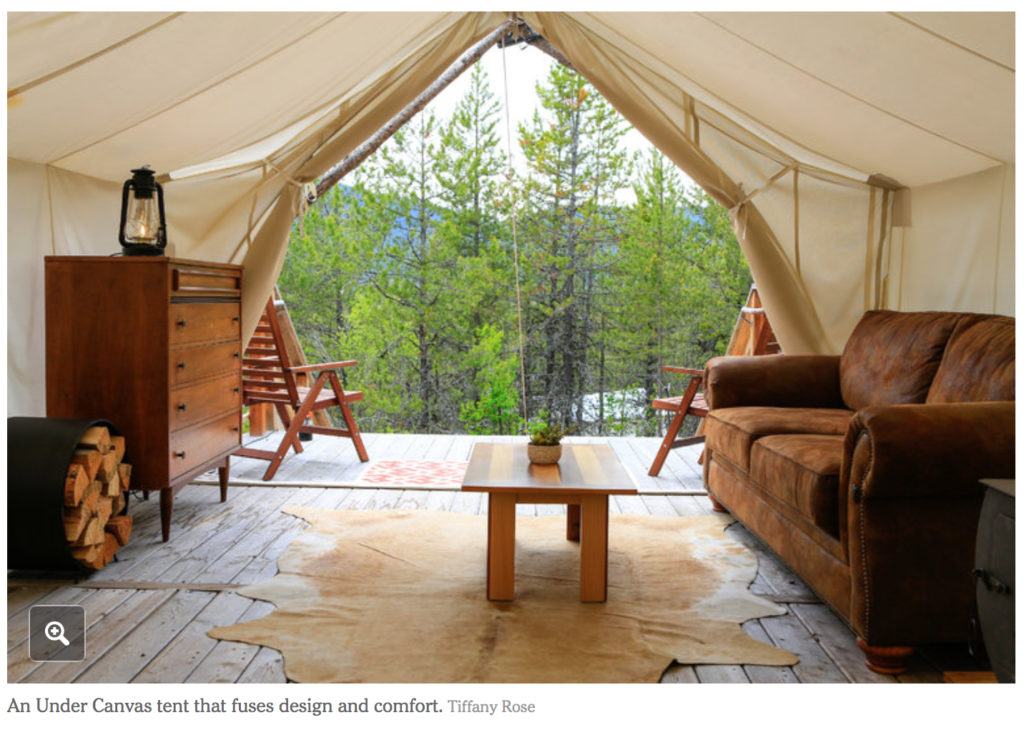
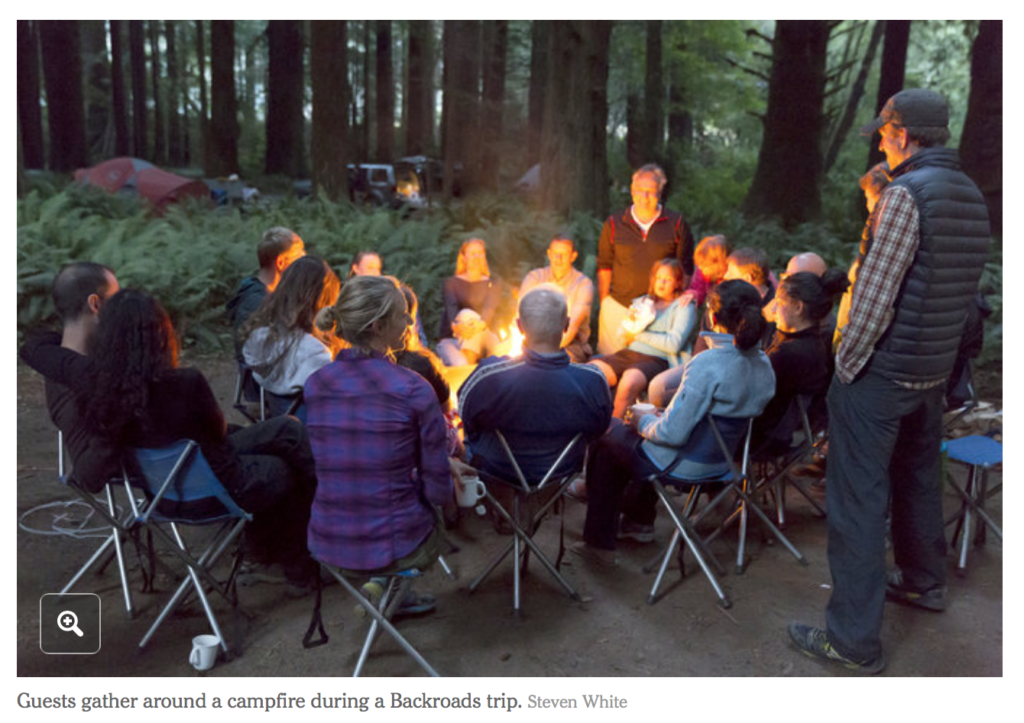
“Glamping Adds a Touch of Luxe to the National Parks”
This New York Times article by “Amy Tara Koch” (August 9, 2016) surveys the world of modern luxury “clamping” and also describes information on guided camping tours by organizations like REI
Food for thought: why do we want to combine luxury — or at least comfort — with “roughing it”?!
Photos from the article:
Articles on Glamping around the World
Six of the best: New Australian glamping camps (2015) — great variety of glimpse including information about “flash camping,” where the tents are moved from place to place.
Best luxury camping ‘glamping’ experiences: 10 of the world’s best (2015) — this sort of list is always highly subjective, but it does include an interesting list of camps world wide, including ones including India, Thailand, Botswana, and Morocco.
National Parks Have Some Work to Do to Become ‘Parks for All’
“Parks for All”-2
KQED Science: http://ww2.kqed.org/science/2016/08/08/national-parks-have-some-work-to-do-to-become-parks-for-all/
By Lesley Mcclure AUGUST 8, 2016
Olive Tambou was shaking when she set up her tent for the first time, on a middle school field trip in Yosemite. She was terrified bears might visit her overnight, but camping beneath massive pine trees changed her life.
“I loved being outdoors,” Tambou says with a huge smile. “It felt natural, really good.”Tambou is originally from Cameroon in Central Africa, and her family traditionally doesn’t spend much time outside.
Now she takes a bus twice a week from her home in Visitacion Valley to the Golden Gate National Recreation Area (GGNRA). Walking along the San Francisco Bay shoreline at Crissy Field, Tambou says she doesn’t mind the three-hour round trip.
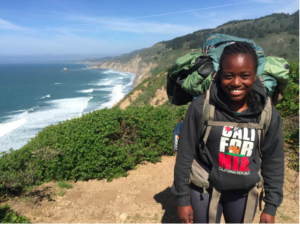
“I love going to parks!” Tambou exclaims, as she spreads her arms to the sky.
She’s part of a high school internship program designed to inspire people of many ethnic identities to care about national parks.
Why Our Green Spaces Are Still So White
Last year, our country’s most scenic parks and cultural monuments drew more than 300 million visitors, but most of them fell in the U.S. census category of “White, non-Hispanic.” The most recent nationwide visitor survey in 2009 showed that only one in five tourists was a person of color. Yet the nation is about twice that diverse.
“They don’t feel a sense of connection,” says Nina Roberts, professor at San Francisco State University. “They just don’t feel that relationship.Roberts researches race and culture in outdoor recreation. She says the parks have struggled to welcome people of all backgrounds.
“‘Parks For All,’ ‘Parks Forever,’ ‘America’s Best Idea’ — a lot of those are clichés in minority communities,” says Roberts, “because they’re still trying to figure out, ‘Okay, I hear that, but I’m not seeing the changes.’”
Roberts says the parks need to make changes that would show people of all backgrounds they’re welcome.
The National Park Service does preserve places that are historically and culturally significant to many peoples. Think of the birthplace of the farmworker movement in California, Aztec ruins in New Mexico, and an African burial ground in Manhattan.
— Park rangers explain flora and fauna at Chrissy Field to a group of visitors from the Mission District who took free shuttles to Chrissy Field.
— Park rangers explain flora and fauna at Crissy Field to a group of visitors from the Mission District who took free shuttles to Crissy Field. (Lesley McClurg/ KQED)
But across the system, most park employees are Caucasian. The uniforms make rangers look like immigration officials. And, Roberts says, many African-Americans, particularly elders, fear the outdoors and carry the scars of slavery and lynchings.
“What people do for leisure, historically, was not spending time in the outdoors,” Roberts says, “because they worked in the outdoors or they were killed in the outdoors.”
Urban Parks for City People
ark Service leaders are aware of these barriers and, since the 1970s, they’ve been trying, somewhat unsuccessfully it appears, to increase diversity to catch up with the country’s shifting demographics. During that decade, Congress created the country’s first urban parks — GGNRA was one of them — and one goal was to attract minorities and low-income people to parks that were closer to cities, so people didn’t have to travel for hours to experience a national park.
‘What people do for leisure, historically, was not spending time in the outdoors, because they worked in the outdoors or they were killed in the outdoors.’Nina Roberts, San Francisco State University
“We have got to bring the natural world back to the people,” said Interior Secretary Walter Hickel in 1970, “rather than have them live in an environment where everything is paved over with concrete.”
Longtime San Francisco activist Amy Meyer remembers a heated Sierra Club meeting one night in the early 1970s, when a woman from Chinatown spoke confidently to the group of white activists discussing land preservation.
Meyer says the woman told them, “‘Look if you don’t get the people from Chinatown to understand what you’re talking about, the next generation is going to pave over Yosemite.’”
On October 27, 1972 Congress established both the Golden Gate National Recreation Area and the Gateway National Recreation Area in New York City. It was the beginning of a wave of urban parks, such as the Santa Monica Mountains in greater Los Angeles, and the Cuyahoga Valley near Cleveland. Today you can visit a national park site in 40 of the country’s 50 most populated cities.
Strategies to Lure New Visitors
Over the years the Park Service has tried numerous outreach programs such as summer camps and free days, designed to attract people of color. Currently, GGNRA is offering free shuttles to the park every Saturday from designated libraries in the Bay Area.
But the parks have stumbled occasionally in their outreach. For example, youth programs used to accept students on a first-come, first-served basis. So for years, the programs filled with white kids from private schools who had savvy parents. In another example, inner city kids are often recruited for beach clean-ups. So their first experience with the outdoors is picking up someone else’s trash.
And there are subtle ways the park has discriminated.
“At a local park here in Washington D.C., for a time, the only signs in Spanish were “No drinking allowed in the park,’” says Alan Spears, director of cultural resources with the National Parks Conservation Association.
— Youth intership camping trip at Point Reyes, CA. From left to right: Lurleen Frazier, Sarah Hoang, Olive Tambou, Stela Zouradakis
— Youth intership camping trip at Point Reyes, CA. From left to right: Lurleen Frazier, Sarah Hoang, Olive Tambou, Stela Zouradakis (Golden Gate National Recreation Conservancy)
Securing the Parks’ Futures
Spears says the marketing to people of color hasn’t worked. The message has to change.
“What we say to them is not, ‘We’ve got a cure for your crappy life with National Parks,’” says Spears. “But rather, ‘We’ve got a park system. It’s increasingly relevant to you and your community and, boy, we really need your help.’”
Help in protecting the park’s future.
By 2050 whites will no longer be the U.S. majority. So Spears says minority votes will be increasingly important.
“Every session of Congress,” he says, “we get someone who thinks it would be a good idea to sell off a portion of a national park in order to put up an outlet mall or something else.”
And it’s not just votes to preserve wild lands. It’s votes to preserve the places that tell the stories of all Americans.
To that end, the NPS has published a Call to Action which outlines priorities for the organization’s future. It states: “In our second century, we will fully represent our nation’s ethnically and culturally diverse communities.”
AUTHOR LESLEY MCCLURG

Lesley is a radio reporter covering medicine, space and environment for KQED Science. Her work has appeared on Marketplace, Latino USA, and NPR’s Morning Edition and All Things Considered. Previously, she covered food and sustainability for Capital Public Radio in Sacramento. She began her media career at KCTS Television in Seattle. You can find her on Twitter at @lesleywmcclurg
Yosemite National Park ranger retires after 59 years
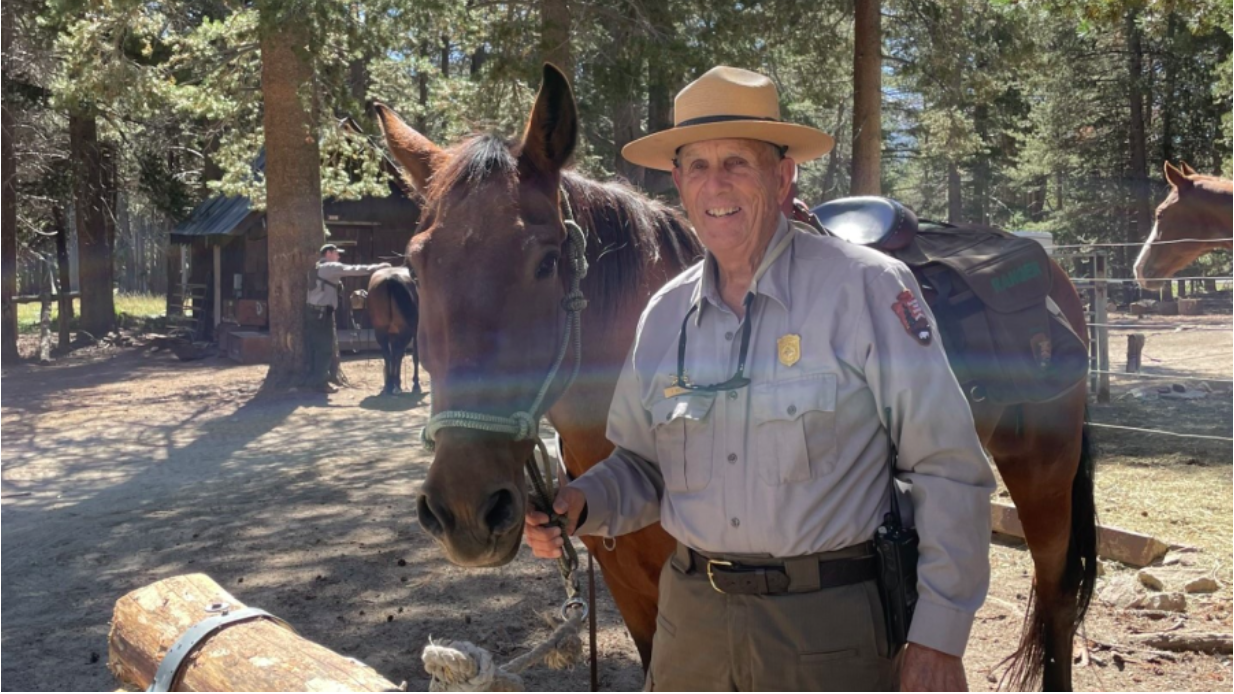
FRESNO, Calif. (KGPE/KSEE) – A park ranger is retiring after 59 years of patrolling Yosemite National Park.
Ranger Fred Koegler is retiring on Monday. He has completed over 200 Search and Rescue missions, most of which were done with the help of his patrol horse of over 20 years, King.
Koegler says he can tell many stories, as he has patrolled since before Tioga Road was paved, keeping notes in his ranger logbook along the way.
“I’m proud to have served Yosemite as part of the greatest Mounted Patrol Program in the country. We need to honor that history. It’s important to share that our Rangers are still riding. King has put in honorable years with the National Park Service, and they need to know he’s served me well. It’s just been an honor,” said Koegler
Fred and his patrol horse King were congratulated by the National Parks Service on their retirement after many years of service.