
About National Park History
Welcome to National Park History!
This section introduces you to this website as a whole and to your instructor.
Yellowstone Falls, 2012 — Yellowstone was set aside as the world’s first National Park in 1872. Click expand buttom on lower right to see ginormous image.
Helpful hint — here is what that expand button looks like: 
During the past half-century, since 1972, I have been teaching environmental history at Eastern Washington University, first in a course called “History of the American Wilderness” and more recently in “History of National Parks.” During the past decade I have been teaching both classes online while traveling across the country and around the world.
Thanks to modern technologies including digital movie-making and online classroom platforms, such as Canvas, I am able to teach my students about far-flung parks while actually visiting them. I can, for example, post the message: “Here is the way that Yosemite Falls looked this afternoon.” And my students in the class can see the falls and read my text immediately.
Along the way, I often meet other park visitors who learn what I am doing and ask if they can take the course, particularly the one on National Parks. In a campground or tourist lodge, I can show them portions of my class, but I have no way of opening access to the course as a whole, which requires enrollment at Eastern Washington. This website, nationalparkhistory.com, is my effort to make the course material more widely available.
It is not an actual pay-to-enroll class with online assignments and grading. Instead, it is a free site with abundant information from my class arranged for casual viewing and self-study.
Navigating National Park History: There are eight sections:
“About” – About this site: You are studying this section right now!
“Class” — The classroom: This is the basic history of National Parks in the United States and elsewhere in the world. My focus here is on American parks, but an international perspective is included and will be invaluable in giving us insights on comparative topics, such as the origin of parks and the place of Indigenous peoples in the parks. The sequence of subjects in this section is based on the historical topics I explore with my students at Eastern Washington University. (This section is in progress. I have an introduction and one lesson so far — nine lessons to go. Stay tuned! )
“Talks” – Fireside talks: These are posts I have written for my students at Eastern Washington University to accompany my classroom materials. In many cases, the “talks” include films I have made “on the road” while teaching my classes.
“Books” – Important books about the parks: Where would we be without good books! This section provides information about some of the most important books about the parks. [Not available yet]
“Documents” — Enhanced documents: These historical documents provide insight into the fascinating story of the national parks. These are “enhanced” in the sense that I have used a number of teaching “devices” to make them more understandable and to underscore the importance of each. In some cases, for example, the documents are outlined or provided with online Quizlets for study.
“Articles” – Scholarly articles: This section is a collection of summaries of articles written by scholars about various topics in park history. Think of it as a sampler rather than an exhaustive list of everything written about the parks.
“Resources” – Information for studying and visiting parks: Look here for basic information about park history, including timelines and park lists for tips on visiting parks. Also find here information on the wonderful array of webcams for viewing parks online.
“News” – It’s in the news: These are clips about notable current events in the parks.
A little about myself
“I want to tell the stories of American history as though I were among friends seated beside a fire.”
Hello, Friends,
I am a Professor of History at Eastern Washington University, and for many years I have taught a course called “The History of the American Wilderness.” Recently I have become interested in teaching about a more specialized field of environmental history, the national parks. My interest in the parks goes way back about 70 years (!) to a time when I visited the Grand Canyon, Zion, Crater Lake, and many other parks as a child with my family on cross-country trips by car. At about that time — long before the internet — I wrote letters to all of the parks asking for information, and one of my favorite childhood memories is of the thick envelopes that came to my house with maps and brochures. (I wish I’d kept them!)
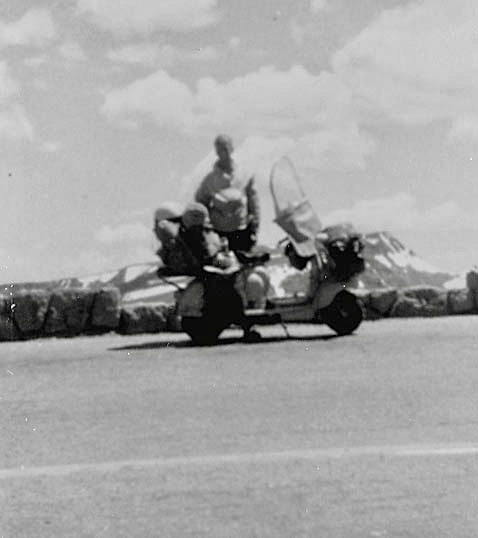
Cross-Country by Scooter — Colorado Rockies 1962
During the summer before my senior year in college, I rode a motor scooter on an 8,000 mile criss-cross-country trip; I camped out every night (without a tent!) for eight straight weeks and visited many national parks. In the summer of 2012 I retraced some of that trip — this time by RV, trailering a motorcycle, nicknamed “Swoop.” Along the way I gathered interviews, information, images, and films about the parks. The picture is a “selfie” I took at one of my favorite campsites along the way, beside the Cimarron River in New Mexico. (The “motto” above is a phrase I entered self-reflectively in my journal some years ago while writing a biography of Eleanor Roosevelt.)
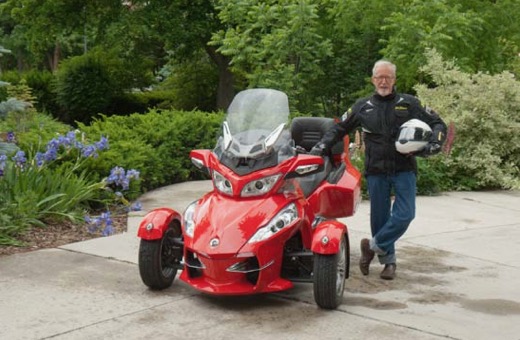
During the past few years I have expanded my explorations to include parks in Australia, Taiwan, the Netherlands, and Svalbard, deep in the Norwegian Arctic. More recently I’ve visited parks in Japan, Equador, Columbia, Barbados, Chile, China, Wales, England, the Kingdom of Jordan, Israel, The United Arab Emirates, Tanzania, and Argentina. Since this History of the National Parks is an on-line course, This Fall (2022) I will be doing some of my teaching on the road while traveling in the United States and, likely. in one or two other countries as yet to be designated. In visiting parks, how we travel can be almost as interesting as where we travel, and so herewith pictures of my more recent wilderness “rigs.” Below is a picture of a Spyder motorcycle that, until recently, I hauled behind a large RV.
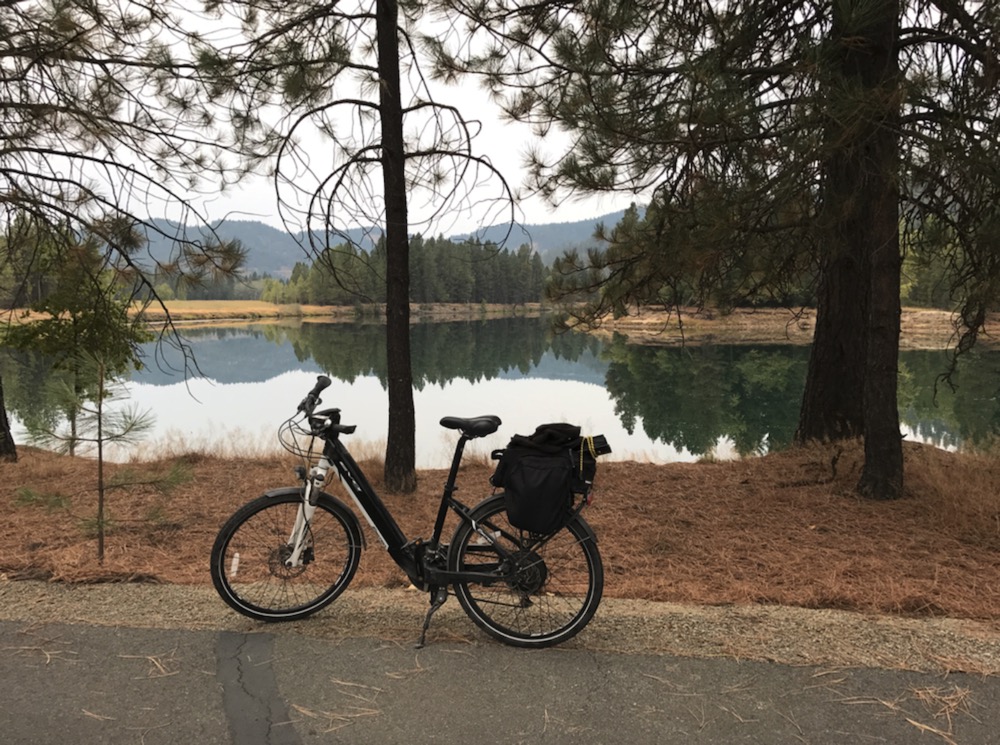
I have “downsized” to a smaller RV (first a Hymer and now a Winnebago Solis) and an electric bicycle, which gives me more flexibility on places I can visit. Here below is the bike on one of the great paths in America: The Trail of the Coeur d’Alenes on the Idaho panhandle.
“Visiting History”
In the case of most historical subjects, you cannot go out and see the actual event. No time machine can take you back to the Battle of Gettysburg, for example, or to the inauguration of George Washington. But in the case of park history you can visit the national parks and see the real subjects, pretty much as, say, John Muir saw them more than a century ago. Park history is accessible, near and far. In Cheney, Washington, where I live, we are within a day’s drive of seven American and seven Canadian national parks, as well as many national historic sites, recreation areas, and other units of national park systems. Additionally, the values that inform the national parks are also apparent in state parks, like Riverside near Spokane, and the city’s own Riverfront Park, near where I live. Additionally, there are many other kinds of wilderness preserves in the United States, and throughout the world. Only a couple of miles from where I teach in Cheney, Washington, there is Turnbull National Wildlife Refuge — one of some five hundred such refuges across the United States. There are probably parks near where you live as well, and one of my goals in this class is to enhance your understanding and appreciation of the ideals of such places.
There are no formal field trips in the class, of course, but I hope you will be able to visit at least one park (whether city, state, or national while you take this class. And I will be providing “virtual excursions” into many parks. All parks are wonderful features of human life. I find that I appreciate them all the more after learning how they came into being, particularly after learning about the role of a force I will call devotion, the hard work of dedicated men and women in creating the parks. I want to share those stories with all of you in the History of National Parks — and I look forward to hearing about your own ideas and experiences in nature through our online discussion posts.
Yours in the spirit of the parks,
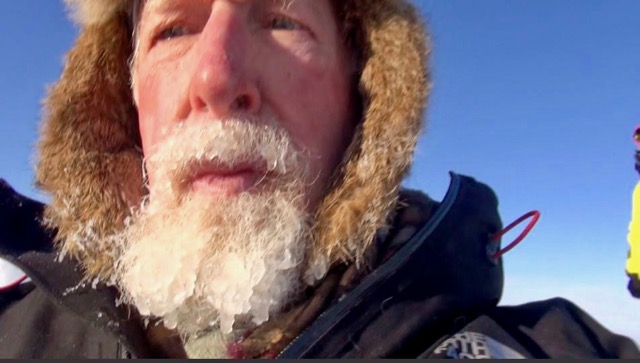
One instructor and one frozen beard, Svalbard, Norway (about 1000 miles north of Iceland)
Video Introductions to Your Instructor
On Technology and the Humanities
A campus interview at Eastern Washington University, discussing new (and old) technologies. I particularly appreciated the way that my colleagues set up and filmed this interview. Although you can’t hear any voices but my own, I had lots of good prompts, which helped me delve into my own life-long love of technology.
A Good Life on the Road
I love to camp, and here is one of my favorite campsites, in New Mexico, where I stayed during the summer of 2012, while traveling with my Spyder motorcycle and my RV.
“Curse You, Patrick Henry!”
I like taking hikes and memorizing poems and documents. But I do find learning my lines is difficult, as this film illustrates.
Brief Résumé
J. William T. Youngs
Professor of History
Eastern Washington University
Robert Reid Lab 107, Eastern Washington University, Cheney, WA 99004
Phone: (509)359-6944, Fax (509)359-4275
E-Mail: jyoungs@ewu.edu
Blog and Web Site: American Realities with Bill Youngs
Education: Harvard (B.A., 1963), Berkeley (Ph. D., 1970)
Teaching Assistant and Acting Instructor, Berkeley, 1967-1970
Kenyon College: Assistant Professor 1970-1972
Eastern Washington University: Assistant, Associate, and Full Professor, 1972-present
Youngs has taught United States history courses in a variety of fields including Colonial and Revolutionary America, the New Nation, American Environmental history, History of the American National Parks, History of Disease, Historical Writing and Editing, and Historical Research
Major Publications:
• God’s Messengers: Religious Leadership in Colonial New England, 1700-1750 (Baltimore: John’s Hopkins, 1976 – winner, American Society of Church History’s Brewer Prize)
• American Realities: Historical Episodes from the First Settlements to the Present (two volumes — Boston: Little, Brown, 1981; Japanese translation, 1984; Eighth Edition: Pearson, 2010)
• Eleanor Roosevelt: A Personal and Public Life (Boston: Little, Brown, 1985 – now published by Pearson – Third Edition, 2005. Also large print and Books-on-Tape editions; Romanian translation, 1997, Chinese translation forthcoming)
• The Congregationalists (Stanford, Connecticut: Greenwood Press, 1990)
• The Fair and the Falls: Spokane’s Expo ’74, Transforming and American Environment. (Cheney: Eastern Washington University Press, 1996 — Washington State Governor’s Writers Award)
• Timeline author for entire world history timeline for the original version of Microsoft’s multimedia encyclopedia, Encarta (1993)
Youngs has received research grants from the American Philosophical Society and the National Endowment for the Humanities, and he is a recipient of the Trustees’ Award at Eastern Washington University and the Burlington Northern Award from Eastern for excellence in teaching and research.
He was lead historian for a three-year project (2002-2005) called “Pathways to History,” funded by a recent “Teaching American History” grant from the Department of Education.
During 2004-2005 he broadcast a weekly commentary on history, teaching, and politics on KEWU at Eastern Washington.
Editor of the Pacific Northwest Forum for twenty years, he now teaches and develops Internet materials in Inland Northwest History. He wrote the lead article on Washington in 1889 for the Centennial edition of Washington Magazine. He published many book reviews in the Seattle Times as well as in scholarly journals. He was convener of the two most recent annual conferences on the Mullan Road and has delivered frequent papers at the conference.
He is currently developing an Internet site (at the URL americanrealities.com) with a historical blog and also sections on his books and classes. Interested in new media, he includes photos, films, sound clips, and “Quizlets” on the site.
Youngs has served on the Board of Trustees of the Washington Commission for the Humanities, and he has led four sessions of the American Studies Conference for Finnish Teachers, which took place in Washington, Idaho, Oregon, and California, 1986-1991. In public service, he created a citizen’s rights groups for an elderly care facility in Redmond, Washington, and edited a newsletter for the family council. He is a board member for HistoryLink.org.
He was president of the Faculty Organization at Eastern Washington (2006-07) and Chair of the History Department (2007-2011) and Co-Chair of the Strategic Planning Council (2006-2009) at Eastern.
He has presented papers to the Organization of American Historians, the American Historical Association, the Pacific Northwest History Conference, the Popular Culture Association, the American Society of Church History, and the Pacific Coast Branch of the AHA. He has lectured at the University of Washington, the University of British Columbia, Stanford University, the University of California at Santa Cruz, and several universities in Finland.
In American Realities Youngs wrote thirty essays focusing on individuals and events in American history, on topics as diverse as the death of a Puritan woman, the rise of Andrew Carnegie, and the bombing of Hiroshima. These essays were his “apprenticeship” in a new kind of historical writing which combines the evocative techniques of fiction with the scholarly research of conventional historical scholarship.
He is currently working on a book about Henry David Thoreau and recently delivered these papers relating to the subject:
• “Henry David Thoreau as Historian,” paper presented in 2010 at meetings of the Bay Area Seminar (Oakland), the Pacific Northwest Early Americanists (Seattle), and the Front Range Early American Consortium (Boise)
• “Was Henry David Thoreau a Preservationist?” paper presented in 2011 at the Front Range Early American Consortium (Cheney) and The Thoreau Society “Annual Gathering” (2012)
Youngs is particularly interested in questions of historical writing style—as suggested by this passage which he wrote in his journal while working on Eleanor Roosevelt:
“I want to tell the stories of American history as though I were among friends, sitting beside a fire….”