
Embracing Wild Nature
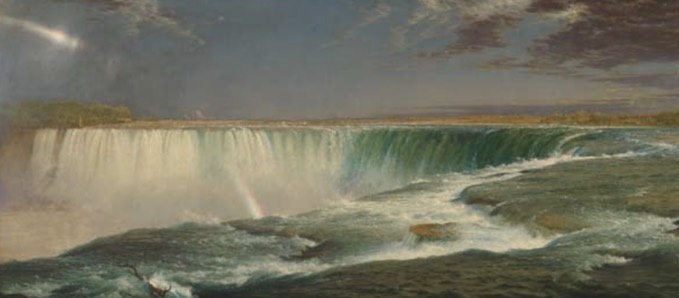
During the early 1800s the possibility of National Parks was nurtured by a new-found appreciation for wild nature, accompanied by a lamentation at the loss of America’s great wilderness landscapes.
In his classic book Wilderness and the American Mind Roderick Nash argues that human beings detested the wilderness until modern times. Traditionally they viewed the wilderness as a place of “wild beasts and wild men”- the realm of the Devil. Nature, they believed, must be conquered not only for the benefit of farms and factories, but also in the name of religion. But that attitude would change dramatically during the nineteenth century.
We can think of this change as coming about as a result of a combination of A,L, and P — Appreciation of the wilderness, Lamentation at its demise, and Preservation as a new movement in American political and cultural life. Click here for more on ALP.
The change in American thought was influenced by previous developments in English literature. During the 1790s English writers such as William Wordsworth and Samuel Taylor Coleridge began writing poetry celebrating the spiritual value of wilderness. Their “romantic” view of nature associated wilderness with “the sublime,” a concept that could be associated with nature or religion — or both.
Many reasons for wilderness appreciation were found and expressed in words during the nineteenth century
Painters also contributed to the new appreciation of nature. The picture above is an example of the work of the nature-appreciating Hudson River School.
Early parks were created at Hot Springs in Arkansas and the Adirondack Mountains in New York.
William Wordsworth published “Tintern Abbey” in 1798 — an early celebration of wild nature.
In America Ralph Waldo Emerson and Henry David Thoreau advocated a more appreciative expression of the ideal relationship of human beings and the natural world.
J. William T. Youngs
Ideology and Action
John Adams once said that Independence was born in the hearts and minds of the American people before the Revolution actually began. Americans were accustomed to discussing “natural rights” before they waged a war and established a government wrapped around those principals. One of their teachers was the seventeenth century British political philosopher, John Locke, who argued that governments exist to serve the people and could and should be replaced if they failed in that duty. In a moment of supreme action, the war against Britain, those ideas provided the rationale for the revolution and for a new government. Long before 1776 the ideas were in place in the colonies that Thomas Jefferson could use in drafting the Declaration of Independence.
OK, so what do the Lockean ideology and the American Revolution have to do with the American national parks?!
That earlier time provides an excellent example of the way that changes in thought can lead to changes in behavior. Lacking a widely held consensus on individual rights, we might never have had the American Revolution, and we certainly would not have had the kind of democratic government that we have today. By the same token before we could have the parks, Americans needed to develop a new way of seeing and understanding the wilderness.
Before there were parks, there was a different attitude towards wilderness than the one that emerged in the mid-nineteenth century. In the days of the first European colonists, the wilderness was regarded as an object, even an enemy, to conquer. The early Puritans, for example, described the American continent as a “howling wilderness.” And “howling” was not for them a term of endearment. It suggested wolves and bears and Indians — oh my!
It also pointed to the backbreaking toil required to do something “practical” with the countryside – to convert tall trees to timber and stony land to prosperous farms. During the nineteenth century that attitude began slowly to change, for some people anyway, and here is where the concept of what I call “ALP” became important as a simple way to remember the three fundamental ingredients in the new way of understanding wilderness.
A is for Appreciation
It was a matter of how you saw an object. Was a tree simply potential profit — board feet of timber? Was a mountain simply a source of mining wealth? Or were these and other natural object valuable in their own right? The question was hardly considered in early America. An exception that proves the rule was Thomas Jefferson’s encounter with Virginia’s Natural Bridge in 1767. This is a natural arch, 215 feet high over a Virginia gorge. Seeing it, Jefferson reported, “It is impossible for the emotions, arising from the sublime, to be felt beyond what they are here: so beautiful an arch, so elevated, so light, and springing, as it were, up to heaven.” (Quoted in Duncan and Burns, 8)
Such praise for natural wonders was rare at the time. That began to change during the 1830s and 1840s as Americans began to develop a deep appreciation for their own forests, mountains, and sea shores. In many cases, the remarkable grandeur of the country’s new lands in the West evoked reactions of astonishment. The Yosemite Valley, for example, found a “voice” in John Muir. In Our National Parks (1901), for example, Muir wrote: “Climb the mountains and get their good tidings. Nature’s peace will flow into you as sunshine flows into trees. The winds will blow their own freshness into you, and the storms their energy, while cares will drop off like autumn leaves.” (Muir, National Parks, 1901, 56) Nature’s grandest scenes, in places like Yosemite, Yellowstone, and the Grand Canyon, encouraged appreciation. But Americans were beginning to be affected by natural beauty on even a more humble scale. Henry David Thoreau, whose influence on Muir was huge, “connected” to wild nature at Walden Pond outside of Boston and crafted one of the enduring classics of American environmental writing: Walden or Life in the Woods. (1854)
L is for Lamentation
At first it may have seemed that appreciation was enough. There were so many forests, prairies, rivers, mountains, and seashores in the United States, that seemingly one could exploit and destroy many of these resources, while still having many more to enjoy. But as the forests fell away and the rivers were polluted, as the carrier pigeon died and the buffalo became nearly extinct, the lovers of wild America realized that something precious was being lost.
Back in 1767 Thomas Jefferson did not need to worry about the loss of animal species or the destruction of entire forests. But by the mid-nineteenth century that had changed. The forests around Walden Pond, for example, were falling to the woodsman’s ax during Thoreau’s lifetime, as were the great forests of Maine, about which he also wrote. John Muir saw and lamented the rapid depletion of forests of ancient Sequoias and Redwoods.
With appreciation for American nature and lamentation at its destruction, the scene was set for a new political movement, but what would it involve. We appreciate the beauty of nature; we lament its rapid destruction. What to do?
P is for Preservation
The answer may seem obvious to us today, long after the founding of so many national and state parks and other nature preserves. But these did not always exist. They came into being during the nineteenth century as men and women began to “connect the dots,” to reflect that the love of wilderness and the sorrow at its destruction could fuel a new kind of political action. And now I’m going to leave you to connect those dots drawing on your initial studies in History 498. How did Americans step up to the plate, so to speak, during the second half of the nineteenth century and begin preserving the wilderness? And along the way how did their own experience of A and L induce them to practice P and create parks?
Reasons for Wilderness
Why should we preserve any wilderness at all?
Weren’t forests made for lumber, mountains for mines, and prairies for farms?
Shouldn’t wild beasts be killed and wild rivers tamed?
Early advocates for wilderness preservation answered these questions with essays and poems and novels and paintings and photographs. They justified preservation for practical reasons and also in response to their own encounters with wild places.
They nurtured a culture that advocated wilderness preservation for aesthetic as well as practical reasons. And they found among the American people millions who were inspired by these writings and images — as well as by their own personal encounters with the wilderness.
William Wordsworth Praises The River Wye
English poet William Wordsworth was a leader in English romantic movement, and he helped Americans, including Thoreau and Emerson, learn to appreciate the beauty of nature. His most famous poem, written in 1798, is “Lines Composed a Few Miles above Tintern Abbey, On Revisiting the Banks of the Wye during a Tour. July 13, 1798.” Understandably the poem is known usually by the shorter title, “Tintern Abbey.” The abbey, however, appears nowhere in the poem, but the River Wye does. During the late fall of 2016, I visited the Welsh village Betws-y-Coed and filmed the Wye, which runs through. See film below — and below that are lines from the poem, mentioning the Wye. (Bill Youngs)
The River Wye, December, 2016
oh! how oft—
In darkness and amid the many shapes
Of joyless daylight; when the fretful stir
Unprofitable, and the fever of the world,
Have hung upon the beatings of my heart—
How oft, in spirit, have I turned to thee,
O sylvan Wye! thou wanderer thro’ the woods,
How often has my spirit turned to thee!
Reading these lines one thinks of John Muir’s statement: “Climb the mountains and get their good tidings. Nature’s peace will flow into you as sunshine flows into trees. The winds will blow their own freshness into you, and the storms their energy, while cares will drop off like autumn leaves.”
Click here for a reading of “Tintern Abbey.”
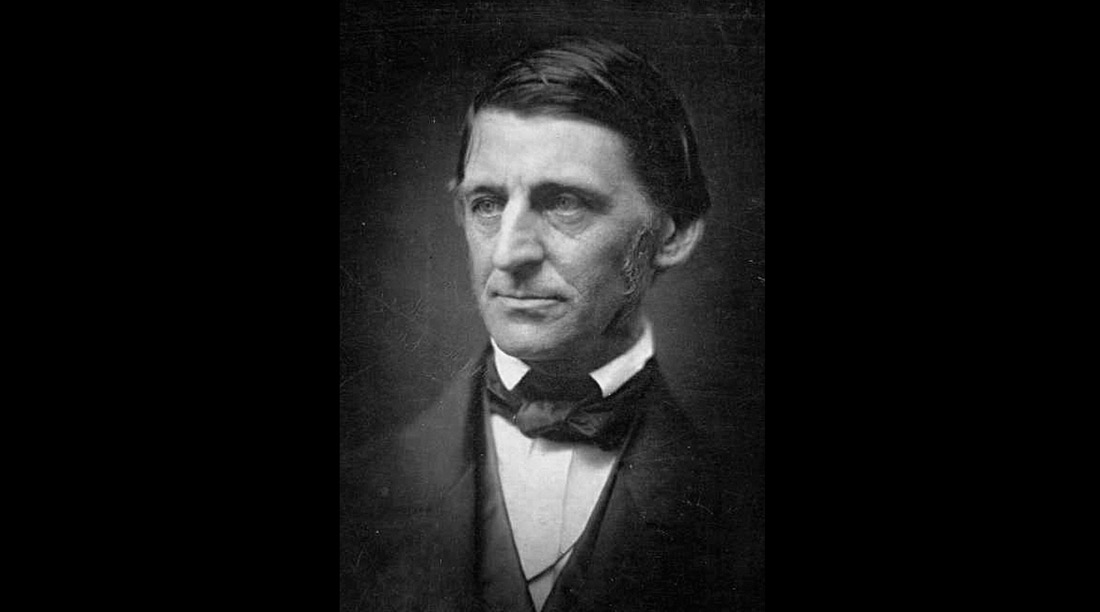
In “Nature,” an essay published in 1836, Ralph Waldo Emerson set forth a soon-to-be classic account of the spiritual importance of nature to human beings. Here is a section of an admirably concise summary of “Nature” in Wikipedia:
In “Nature”, Emerson lays out and attempts to solve an abstract problem: that humans do not fully accept nature’s beauty. He writes that people are distracted by the demands of the world, whereas nature gives but humans fail to reciprocate. The essay consists of eight sections: Nature, Commodity, Beauty, Language, Discipline, Idealism, Spirit and Prospects. Each section takes a different perspective on the relationship between humans and nature.
In the essay Emerson explains that to experience the “wholeness” with nature for which we are naturally suited, we must be separate from the flaws and distractions imposed on us by society. Emerson believed that solitude is the single mechanism through which we can be fully engaged in the world of nature, writing “To go into solitude, a man needs to retire as much from his chamber as from society. I am not solitary whilst I read and write, though nobody is with me. But if a man would be alone, let him look at the stars.”
When a person experiences true solitude, in nature, it “take[s] him away”. Society, he says, destroys wholeness, whereas “Nature, in its ministry to man, is not only the material, but is also the process and the result. All the parts incessantly work into each other’s hands for the profit of man.
The wind sows the seed; the sun evaporates the sea; the wind blows the vapor to the field; the ice, on the other side of the planet, condenses rain on this; the rain feeds the plant; the plant feeds the animal; and thus the endless circulations of the divine charity nourish man.”
Key passages from “Nature”
“Crossing a bare common, in snow puddles, at twilight, under a clouded sky, without having in my thoughts any occurrence of special good fortune, I have enjoyed a perfect exhilaration. I am glad to the brink of fear.”
“In the woods, we return to reason and faith. There I feel that nothing can befall me in life,—no disgrace, no calamity, (leaving me my eyes,) which nature cannot repair. Standing on the bare ground,—my head bathed by the blithe air, and uplifted into infinite space,—all mean egotism vanishes. I become a transparent eye-ball; I am nothing; I see all; the currents of the Universal Being circulate through me; I am part or particle of God.”
Henry David Thoreau and Walden Pond

Henry David Thoreau Laments the Death of a Pine Tree
His description of “The Felling of a Pine” near Walden Pond turns on its head the assumption that nature is bad and man is good.
In this journal entry we see Thoreau’s feelings about cutting down a pine tree. Thoreau’s sorrow at the “death” of the tree reveals a profound appreciation for nature and foreshadows a movement in the United States aimed at preserving wilderness.

Walden Woods, July 11, 2016 (Beautiful, but with nary a tree four feet in diameter!)
Tuesday Dec 30th, 1851 This afternoon being on Fair Haven Hill, I heard the sound of a saw-and soon after from the cliff saw two men sawing down a noble pine beneath about 40 rods off.
I resolved to watch it till it fell – the last of a dozen or more which were left when the forest was cut and for 15 years have waved in solitary majesty over the sproutland. I saw them like beavers or insects gnawing at the trunk of this noble tree, the diminutive mannikins with their crosscut saw which could scarcely span it. It towered up a hundred feet as I afterward found by measurement – one of the tallest probably now in the township & straight as an arrow, but slanting a little toward the hill side – its top seen against the frozen river & the hills of Conantum.
I watch closely to see when it begins to move. Now the sawers stop – and with an axe open it a little on the side toward which it leans that it may break the faster. And now their saw goes again. Now surely it is going – it is inclined one quarter of the quadrant, and breathless I expect its crashing fall. But no, I was mistaken. It has not moved an inch; it stands at the same angle as at first. It is 15 minutes yet to its fall.
Still its branches wave in the wind as if it were destined to stand for a century, and the wind soughs through its needles as of yore; it is still a forest tree – the most majestic tree that waves over Musketaquid. The silvery sheen of the sunlight is reflected from its needles. It still affords an inaccessible crotch for the squirrel’s nest – not a lichen has forsaken its mastlike stem – its raking mast – the hill is the hull.
Now’s the moment – the mannikins at its base are fleeing from their crime. They have dropped the guilty saw & axe. How slowly & majestically it starts – as if it were only swayed by a summer breeze and would return without a sigh to its location in the air – & now it fans the hill side with its fall and it lies down to its bed in the valley, from which it is never to rise, as softly as a feather, folding its green mantle about it like a warrior – as if tired of standing, it embraced the earth with silent joy – returning its elements to the dust again.
But hark! there you only saw – but did not hear. There now comes up a deafening crash to these rocks – advertising you that even trees do not die without a groan. It rushes to embrace the earth & mingle its elements with the dust.
And now all is still once more & forever both to eye & ear. I went down and measured it. It was about 4 feet in diameter where it was sawed – about 100 feet long. Before I had reached it-the axe-men had already half divested it of its branches. Its gracefully spreading top was a perfect wreck on the hill side as if it had been made of glass & the tender cones of one years growth upon its summit appealed in vain & too late to the mercy of the chopper. Already he has measured it with his axe-and marked out the mill logs it will make. And the space it occupied in upper air is vacant for the next 2 centuries.
It is lumber. He has laid waste the air. When the fish hawk in the spring revisits the banks of the Musketaquid, he will circle in vain to find his accustomed perch & the henhawk will mourn for the pines lofty enough to protect her brood.
A plant which it has taken two centuries to perfect rising by slow stages into the heavens – has this afternoon ceased to exist. Its sapling top had expanded to this January thaw as the forerunner of summers to come. Why does not the village bell sound a knell? I hear no knell tolled. I see no procession of mourners in the streets – or the woodland aisles. The squirrel has leapt to another tree; the hawk has circled further off & has now settled upon a new eyre, but the woodman is preparing to lay his axe at the root of that also.
You can understand this passage more fully by taking the “Quizlet” below.
Quizlet on Henry David Thoreau and the Felling of a Pine
In this essay, delivered at a Thoreau Conference at Walden Pond, Bill Youngs discusses Thoreau’s ideas about wilderness appreciation and preservation.
Here is a short film depicting Walden Pond on a winter day.