

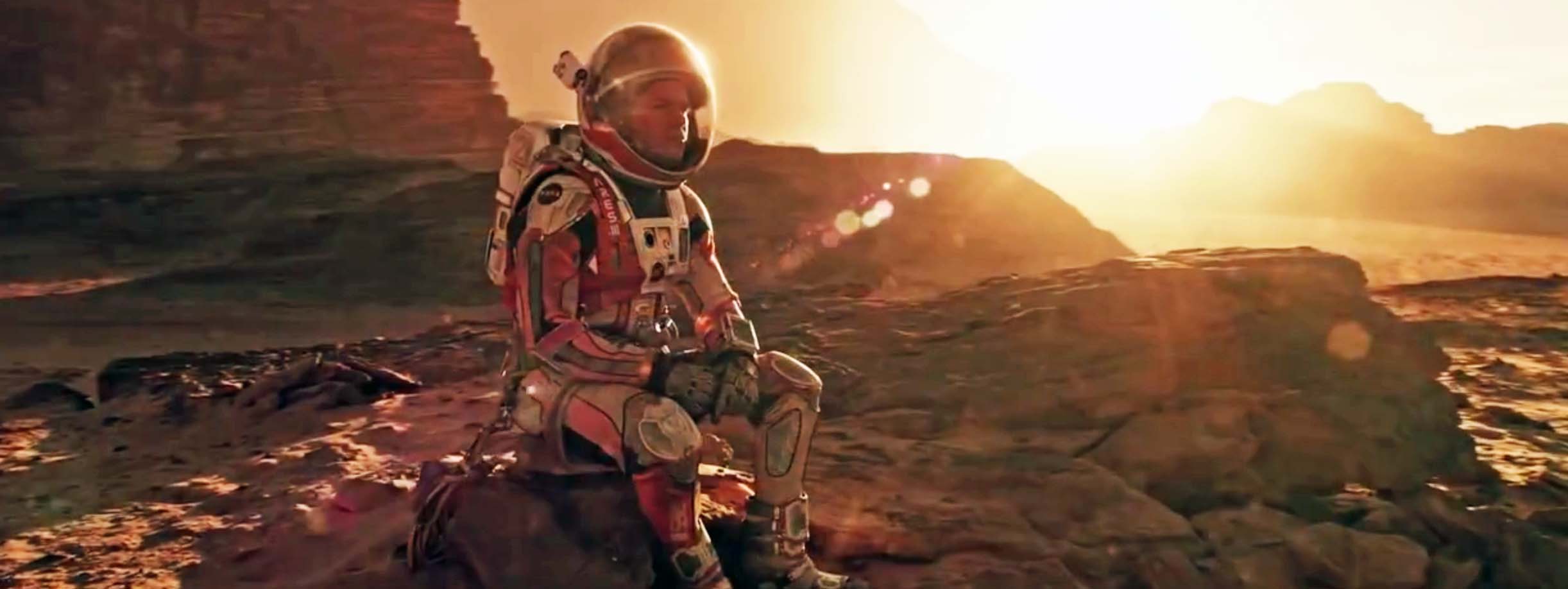
One (of many) recurrent themes in History 373 is the question of the ways in which and the degree to which we expose ourselves to the wilderness. And which of these ways and degrees seem legitimate — as measured by our class standards — and which levels of exposure seem just plain wussy. Does it count if you go the the wilderness in an RV? (I’ll weigh in on this in a while.) Does it count if you have a tent — but the tent has no bullet holes?! (McManus)
I’ve just seen “The Martian” and the central figure, Mark Watney, the left-behind astronaut, has all sorts of protective gear separating him from the wilderness. But let’s give him credit for these two things: 1) he does seem to appreciate the Martian landscape — a wilderness without bears, but none-the-less a wilderness; and 2) he really needs all that gear. Remember how McManus and friends persuaded themselves that they needed all sorts of superfluous gear because they felt hardy in carrying it along? Well, Mark Watney really, really needs that survival suit and the controlled-atmosphere of pod and rovers.
Now, lets turn to Tyler in “Never Cry Wolf.” He starts out almost as outfit-fortified as Mark Watney on Mars — and he probably felt just about as far from home. But unlike Mark on Mars, Tyler in the Tundra loses his protective gear. Here is that scene from “Never Cry Wolf.
By miraculous endeavor Tyler saves himself, as does Mark. But while Mark restores his protective shell of space-outfit and man-made shelters, Tyler discards his citified-ways and moves in along side some wolves. While Mark plants potatoes and “colonizes” mars, Tyler learns wolf lore and, well — and eats mice!
Their paths diverge even more when Mark travels in his little bubble of life-support equipment and heads for a spacecraft to take him home, while Tyler strips buck naked and prances about with caribou and wolves.

For perspective on the subject of our “shells” and the wilderness, here is a wonderful passage from a book by Peter Stark called Last Breath about life on the edge — and sometimes over the edge. In this case Stark is referring to an escape from death in the desert and the appeal of exposing oneself to danger and stripping off the protective layer of civilization. I think it provides a useful perspective on our friends Mark and Tyler:
Like the oxygenless summit of a Himalayan peak or the silent, motionless cold of a 40-below-zero Arctic night, the desert teaches you just how thin that layer of life is, and how fragile your own hold on it. Stepping beyond that fragile layer is no more difficult than shedding your clothes on a cold winter night or walking for a few hours without water in the hot sun. And when you finally do step beyond it, the ego, the vanity, the insignificance, and—often—the pettiness of so much of what passes for human endeavor and striving become abundantly clear. This is what the great religions and the shamans and the Sufi all are trying to tell you—to step beyond the self that blinds you, as the Sufi knows, having stripped away material wealth and worldly ambitions in his pursuit of union, spinning with ecstasy under the stars in the naked desert night. This is why you climb mountains, and paddle whitewater rivers, and trek into the desert, and seek out remote places; to strip away the superfluous, to remove the protective boundaries between that thing you call a self and something larger. Your body still lies weakened and half shriveled, slowly taking on water to restore itself fully to life, but already as you lie in the sand with the flames of the fire jumping into the night, the desert tempts you back to it. The mountains tempt you to climb them. The rivers tempt you to run them. The remote places beckon. It is not a question of whether you will go again. The question for you is: where next? And the other question is: how far?!
Tyler escaped those “protective boundaries” while Mark Watney clung to them as if his life depended on it.
But then, in Mark’s case, his life did depend on that shell. He would not have lasted a minute dancing naked across the Martian landscape.
What is the moral of this story? Well, I’ll leave that to you to figure out and assign to it your own conclusions.