
Note: earlier on this quarter we had another visit to Taroko National Park in Taiwan, focusing on a local resident and a motor scooter. We will see them again in this post, but this is a larger post, telling us a lot more about the park. I wrote the original Talk, below, during a visit to the park in 2014. As we near the end of the Fall Quarter, you will have noticed that through announcements and Fireside Talks, as well as in our Talk sessions, I have been encouraging you to think about some broad themes in National Park history. In particular after we worked our way as a nation through ALP–appreciation, lamentation, and preservation–and created national parks, we had to decide what to do with the parks. We have read about and discussed many facets of this subject, ranging from policies towards the animals in the parks to the appropriateness of particular kinds of park fences and benches. All of these discussions come back to this classic formulation of the park ideal in the Organic Act of 1916, which created the National Park Service, with Stephen Mather as it’s head: The service thus established shall promote and regulate the use of the Federal areas known as national parks, monuments, and reservations hereinafter specified by such means and measures as conform to the fundamental purposes of the said parks, monuments, and reservations, which purpose is to conserve the scenery and the natural and historic objects and the wildlife therein and to provide for the enjoyment of the same in such manner and by such means as will leave them unimpaired for the enjoyment of future generations. As I write this post in an apartment on the campus of Soochow University in Taipei, Taiwan, I intend (1) to tell you the story of one of the great national parks in Asia, and (2) give you a comparative perspective on how this park has approached certain park management challenges that will be familiar to us in History 452. Over this past weekend I visited the park with Jonathan Butler, a member of the English Literature faculty at Soochow and a mighty hiker and fan of Henry David Thoreau. On Saturday morning, November 22, 2014, we took a bus from our hotel in the nearby city of Hualien to Taroko National Park. This is me at a boulder marking the park entrance:
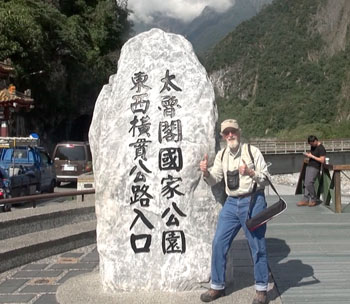
Behind me in the beginning of the Taroko gorge, which is sometimes called the Grand Canyon of the Pacific. Because you enter on the valley floor, I think it is actually more comparable to Zion. A few hundred yards from this stone we walked toward the visitors’ center. Along the way we came upon this lovely tree with an attractive fruit. Luckily in Taiwan as In the United States the park had plenty of signage and we were warned in Chinese and English that the fruit of this particular tree was poisonous. Like many an American park sign this one included a biology lesson, explaining how the tree propagated others of its species without the help of animals dispersing its fruit. Here is that tree:

As at most American National Parks the visitor’s center at Taroko furnished a good museum with information on local geology, flora, and fauna. Additionally it had ample information about the indigenous people of the region, including this map of tribal locations.

We also saw some good drawings of the ancestors of the Taroko people, including this one:

As we shall see, we learned a lot more about Taroka’s indigenous people during the next two days. As an initial hike we decided to take one of the most famous in the park, up the main Taroko Gorge along the famous Shakadang Trail. We decided to hike from the visitor’s center up the road to the trail head.
In history 452 we have often discussed park friendly trails. This initial one was certainly not people friendly. For about 15 minutes we were walking on a narrow concrete-block path beside a highway with tour busses rushing by. At the end of the tunnel we descended a steel staircase, about ten flights high, that was built for function rather than form. Here is what it looked like:

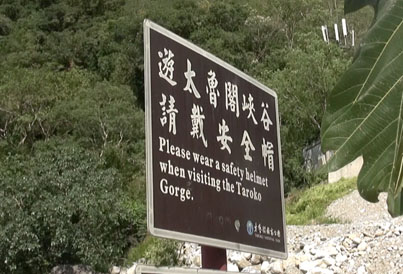
At the bottom, just as we were starting along the trail, we read this sign. In History 452 we have talked a lot lately about danger in the parks. Here was a new kind of danger: people have actually been killed on the trail ahead by falling rocks. We learned later that you can actually take out free loaner helmets at the visitor’s center. But of all the men, women, and children we saw on the trail ahead, none was wearing a helmet. However, maybe we should have been: I learned later that a visitor from China was killed by a falling rock on the gorge trail just last spring. Here is that sign:
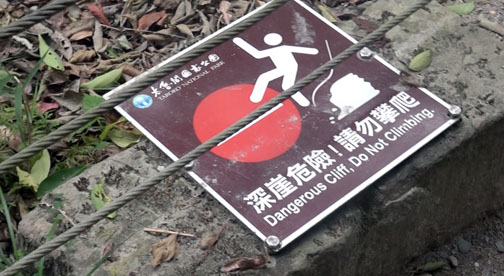
As in an American park there were rules on park behavior:
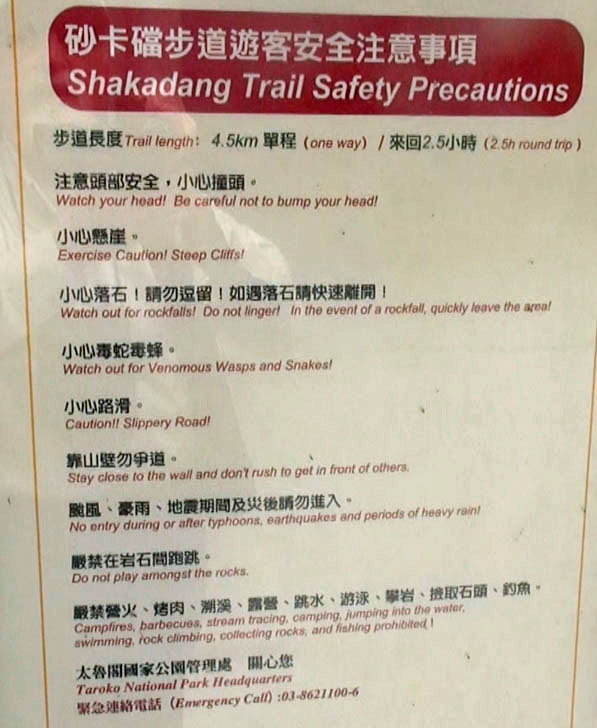
All of this made good sense, although at a certain age, I would have found it hard not to “play amongst the rocks”!
We walked on and soon it was apparent why this is one of the most famous trails in Asia. It was cut into a rock face allowing views of the canyon and the river below that would otherwise have been inaccessible. Here is the trail and some of those views:
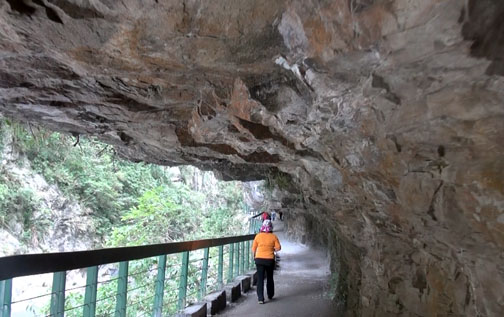
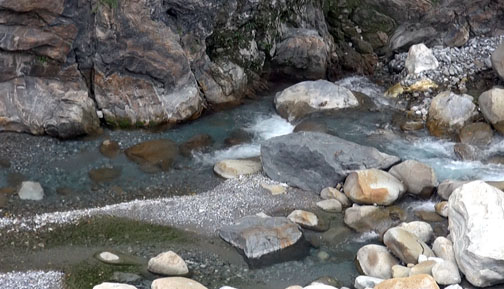
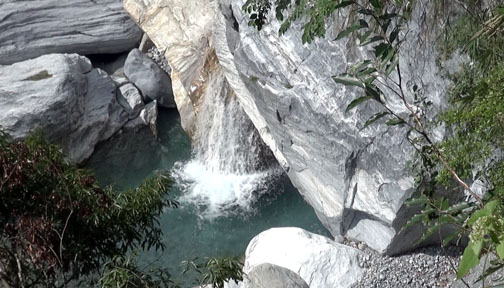
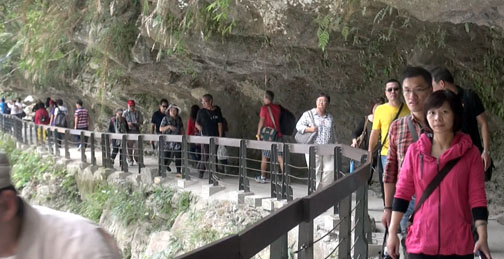
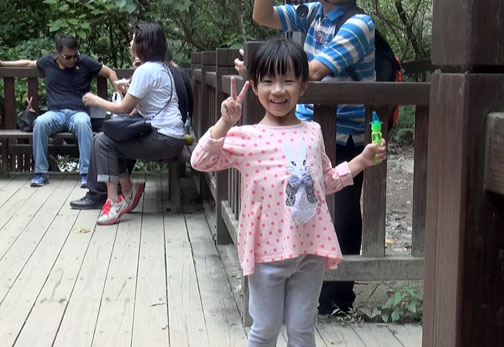
The trail was cut into a sheer rock wall, and dropped off vertically on the side toward the river. We were respectful of the signage and did not “climbing.”
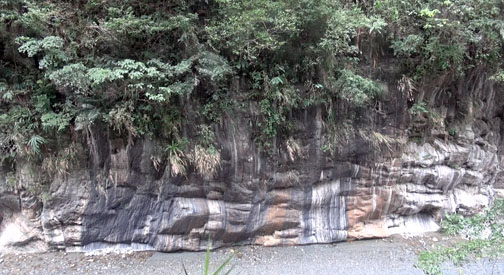
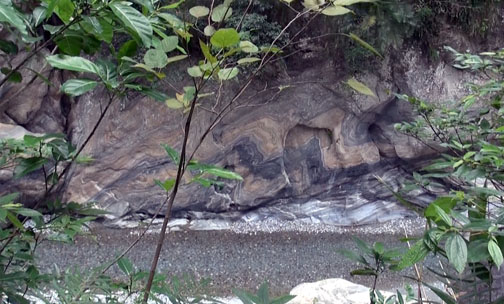
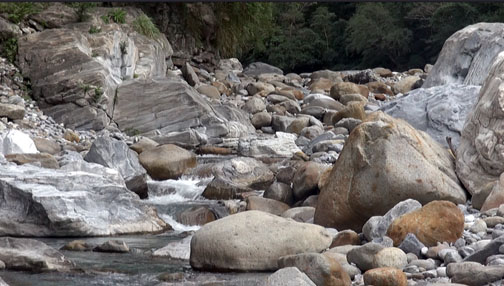
The rock wall across the river and in the stream bed formed a geologist’s textbook:

Although the trail was crowded, our fellow travelers spoke softly and were respectful of nature. Their presence did not detract from my enjoyment of the scene. In fact, there was a certain satisfaction in sharing this beauty with others. But there was one exception. About halfway up the mile-long trail in the rock, I heard the distance sound of a motor scooter gunning down the trail:
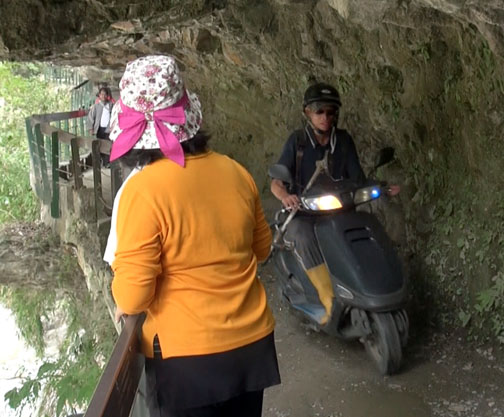
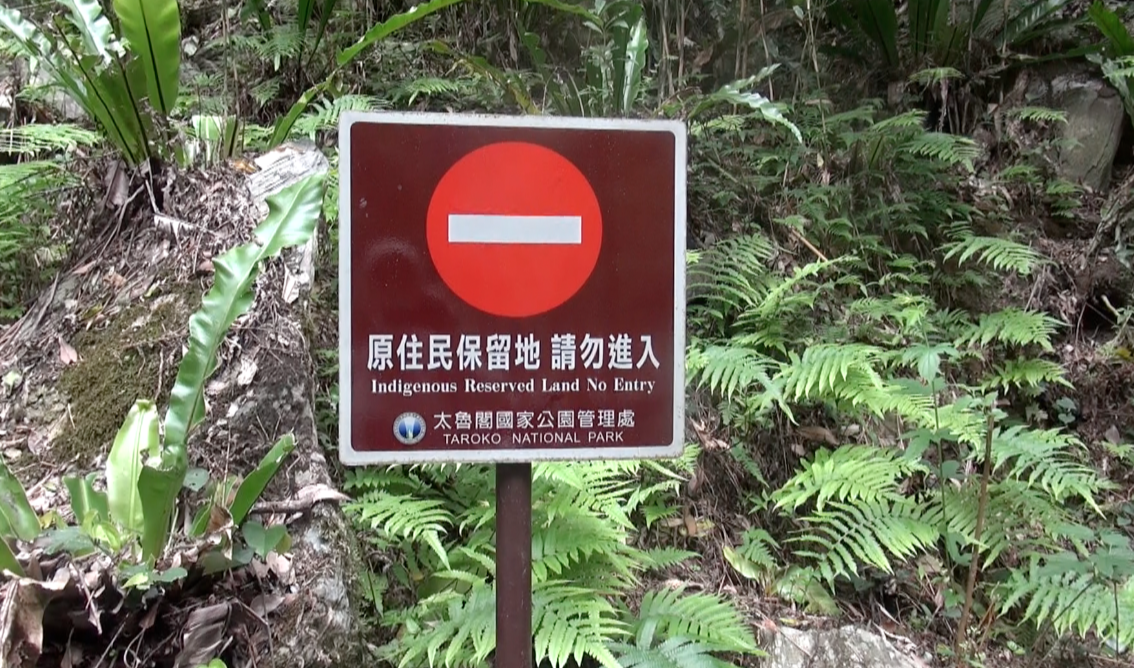
What was this guy doing, I wondered, riding a motor scooter on a National Park trail? The answer provided a valuable insight into the way that the indigenous people of Taiwan fit into the park picture. Thinking about it I realized that I had had hints of this all along the trail, indications that the members of the Taroko tribe had not disappeared or been relocated. This sign explained that the land alongside parts of the trail were closed to tourists and reserved for indigenous persons.
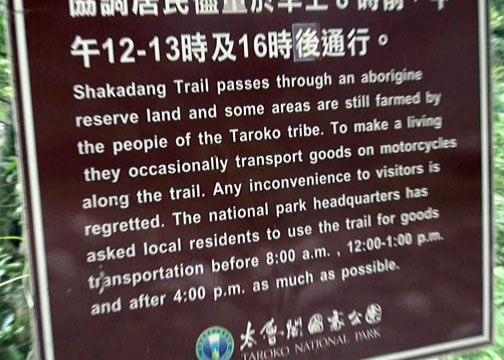
The following sign explained exactly why the motor scooter was allowed on the trail and what sort of person was riding it:
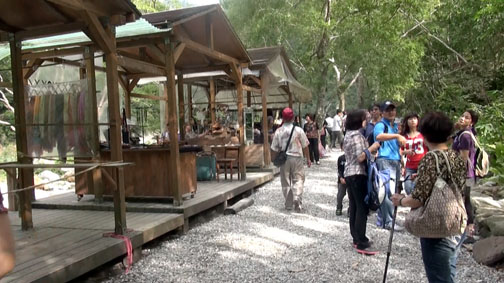
Further on up the trail we had a chance to see some of the goods that had been presumably moved by scooter. We came to a cluster of open-air shops where Taroko men and women were selling objects they had made:
The man in this picture is weaving in a traditional Taroko style:
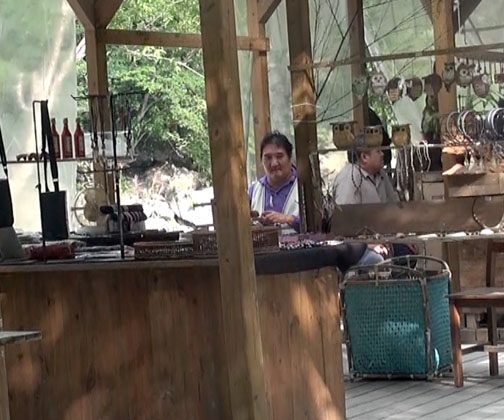
Here is some of the “tape” he had woven for cutting into cloth bracelets. (I’m looking at mine as I am writing this.)

And this is Maria, from whom I bought a locket for my Granddaughter Charlotte for her seventh birthday:
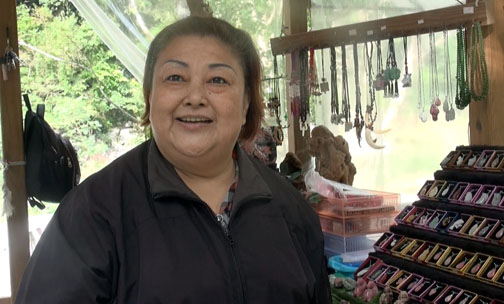
Here were some of my choices for a locket — Maria’s husband had made them:

At my request Maria wished a happy birthday to Charlotte in Chinese and in her own native Taroko. In case you want to expand your own language knowledge, here she is with those two greetings:
I will be adding more to my report on Taroko National Park, but for the moment I wanted to see what we could learn from this preliminary post. I suggest you consider these (among other possible) questions:
1) What do we think of Taiwan’s policy for the indigenous persons in Taroko. Should they be allowed to sell traditional goods — and, as it turned out, light snacks as well — in the National Park? Should the Tarokos be allowed to ride motor scooters on there Shakadang Trail — while you and I cannot? Did you notice the prescribed hours for such riding? Do they make sense?
2) How did you feel about the trail itself? Was it park friendly? Did it succeed is making accessible to tourists the beauty of the river valley?
3) What did you think of having to share the trail, on this virtual journey, with so many other persons? Did it result in “loving the region to death”?
4) What about the signage? Was it basically similar to or different from signage you would encounter in American parks?
5) What notable similarities and differences do you see between this Taiwanese park and ours? Could they learn anything from us? Could we learn anything from them? Could they learn anything from our signage topics?