
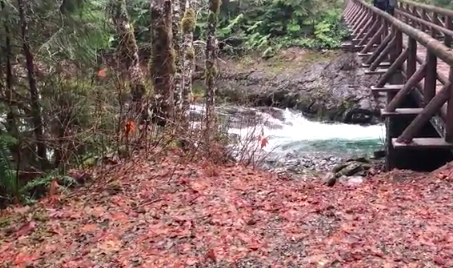
(Note I visited the Opal Creek Wilderness region on the weekend of December 1-3, 2017, and wrote this talk during the following week.)
I am calling this final Fireside Talk “Return to Opal Creek” even though I had never even been to Opal Creek until the fall of 2017. The reasons are two:
— (1) I first encountered the documentary “Rage Against Trees” back in the day when videotapes were the latest thing. That was about 1988, and I used the film regularly for the next few years in my American Wilderness class. But that was several media generations ago, and that old tape was pretty much useless.Finding the film as a DVD on interlibrary loan was like reconnecting with an old friend. And in reading your comments, I have been delighted to find that the documentary is easily as powerful today as it was a generation ago!
— (2) The second reason that I call this post a “return” to Opal Creek is that my impression of the place was so strong in the film that I almost felt that I visited the site long ago. This past weekend, yesterday in fact, I visited Opal Creek in real time in real life.
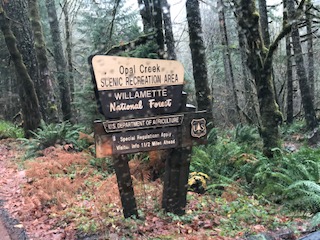
When you hike into the Opal Creek region, this sign welcomes you.
In telling my Opal Creek story, I find it useful to move between narrative and reflection, hoping in this way to tell you what Opal Creek is like today, and also to provide a summary and reflection on some of the major themes of the class. Here goes:
Narrative (1) — Checking into Willamette National Forest
A few days ago I was not even certain where Opal Creek is, how to get there, and where to find the ancient forest. Google to the rescue, where I learned that the NFS (National Forest Service) administers Opal Creek, the forest headquarters is in Detroit, Oregon, and that is about 120 miles south of Portland. I called the service and talked to a couple of helpful personnel, arranging to come by last Friday afternoon for more information.
— To my surprise, although folks at the headquarters sort of knew about “Rage Over Trees,” none of them had ever seen it, and they did not have it. Problem-to-be-solved, I brought along a thumb drive with the video.
Leaving from Seattle Friday morning, I arrived in Detroit late that afternoon, and had a conversation with one Jeff Lunsford. Very useful. It turns out he is one of the “bit players” in the film, trying back in the day keep the confrontation peaceful. Here is Jeff:
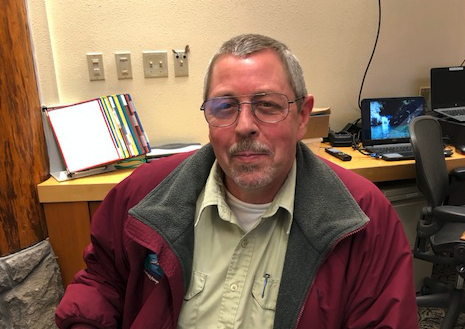
Jeff has been in forestry in the Opal Creek region for about 30 years and is a font of information. Before joining the Forest Service he was a timber “cruiser” — someone who evaluates a stand of timber for sale. He confirmed that the film got it right in terms of the parties and passion in “Rage Over Trees.” Some other information I got from him:
— The government did indeed preserve Opal Creek as a wilderness area.
— But at about the same time they allowed logging in another ancient forest in Oregon with trees from eight to ten feet in diameter.
— But nowadays, timber in the region is cut carefully and selectively, thinning by helicopter, where a stand as a whole (as well as the timber industry) will benefit.
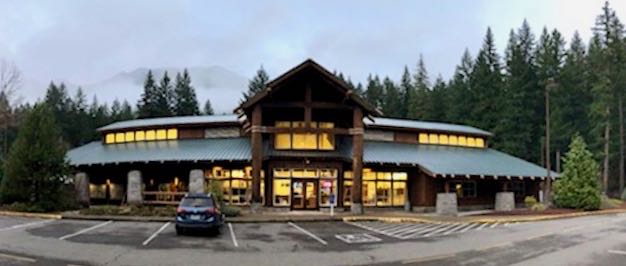
It was getting dark outside, and I needed to find a place to “camp” for the night. But before leaving the NFS headquarters, I will add that it was a fine facility, built to fit with the environment and rich in books and displays. Here is a shot from outside as I was leaving Friday evening:
Luckily “leaving” did not mean going very far. If I had been true to the calling of History 453, I would have experienced that night “a fine and pleasant misery” camped at the side of the road. Instead, it turned out that right across the street from the FCS headquarters was Detroit Lake State Park, one of a number of excellent Oregon state parks that are open for “camping” all year long. I chose a site near the lake and was one of perhaps eight campers — all but one in RVs — in a campground that must have had easily one hundred sites during summer months.
Reflections (1) — First Impressions
Venturing forth to a place I only knew from a film made almost thirty years ago, I felt fortunate in meeting a friendly reception at the forest headquarters and comfortable campground just across the street. I liked the countryside I had driven through to Detroit — forests and streams by the highway. Walking out to view the lake before settling in, I loved the sound and scent of the pine trees in the park.
I reflected that Jeff had told me about a landscape that encapsulated major themes in The History of the American Wilderness. After the utilitarian carnage that has eliminated most of the ancient forests in the United States Opal Creek was a victory for preservation — while admittedly another, smaller ancient forest had apparently succumbed to lumbering while all eyes were focused on Opal Creek. And yes, trees were still being felled in the area, but selectively, leaving much of the forest to thrive.
Narrative (2) — On to Opal Creek
Saturday morning, I arose bright and early to enjoy sunrise in the wilderness.
Well, truth be told, I first confronted a classically McManus challenge — piles of supplies that had all but taken over my life. No sleeping bags stuffed with chickens, thank goodness. I am still coming to terms with my new RV — downsized from a much larger rig that had grown too cumbersome for comfort. So far I am in my might -need-this stage of outfitting myself, and it was hard to move or even find space for my computer so that I could do a little work on History 373.
Finally, I was ready to set out to trace my way back to Gates, Oregon, where I turned onto a narrow road up into the foothills leading to Opal Creek. I loved this road: it was well paved but had the curves and dips of a gravel Forest Service road — but without the potholes. The sky was overcast with a light drizzle. The damp roadway and forests sparkled. On the distant hills clouds of mist added to the magical scene.
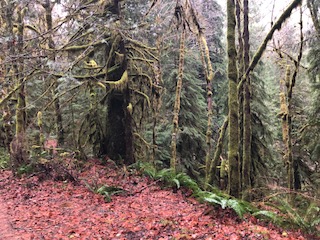
As the forest thickened I felt at times that I was in a scene from a hobbits movie — or even “Avatar.” As I left pavement for a beat-up gravel road, I experienced a touch of “misery” in this idyll: the potholes in the road the wilderness area could have concealed a large pig, and were so abundant that they were hard to miss.
Don’t believe me?
Here they are, each one six inches deep or deeper and filled with water.):
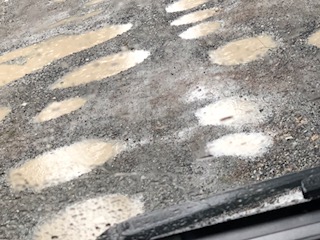
They were even harder to miss when I drove back down in the dark. Stay tuned!
Eventually, I reached the trailhead parking area. About a dozen other vehicles were already there — a good crowd for a cold and rainy day, but not so many “tourists” as to create a sense of crowdedness. As I set out to hike the rain was clearly here to stay, and I was glad I was prepared in full body rain gear — not only a rain jacket, but also rain pants.
Outfitting note: I cannot recommend rain pants enough. Clearly, keeping one’s upper body dry is paramount, but on a cold day, on a long hike, wet legs are outright debilitating. In my raid gear I felt as secure as Mark Watney in his space suit on Mars — without an antenna poked in my side!
At this point I hope to take you with me into the Opal Creek Wilderness through some of the photos I took along the way.
Here is an example of a forest designed for Hobbits:
The Bridges on the Roadway-Trail Honored the Landscape
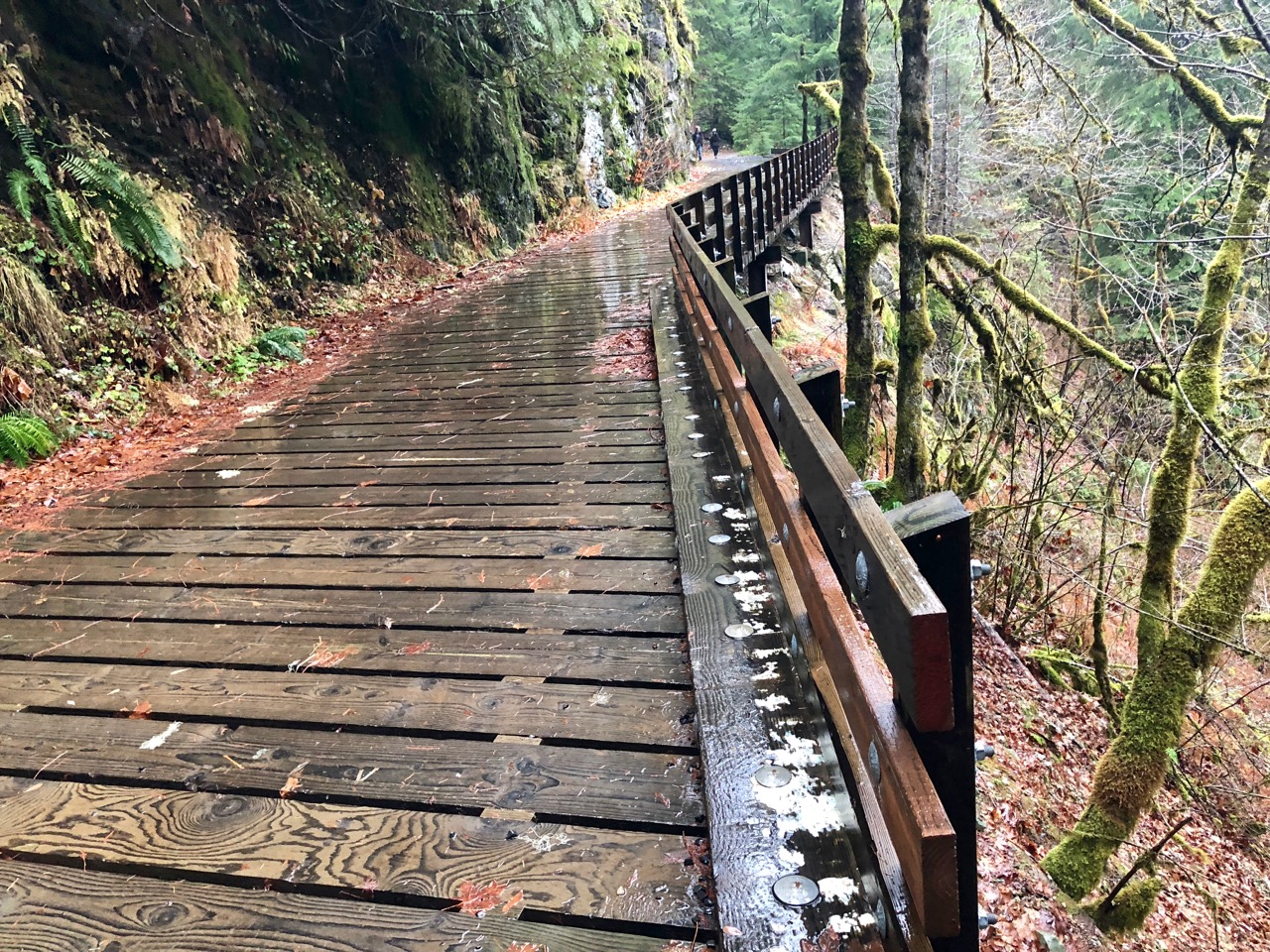
As the trail narrowed, so did the bridges.
Narrower, and still narrower.
The views of the river were beautiful.