
Fireside Talk: Jackson Hole Journal, November 7-11. 2018
One of the things we learn in the History of National Parks is to recognize ways in which distinct park phenomena are part of wider patterns or topics. During the past four days, I have tested that concept while visiting Jackson Hole, Wyoming, and the Grand Teton National Park. In this “talk” I will present a series of mini-lessons consisting of: a brief description, an image, and reflections on the topic suggested by the image. As you read through, pause on the image, and ask yourself what broader topic is suggested. OK, here we go….
A Plane Landing at JAC, the Jackson Hole Airport with the Grand Tetons in the Background
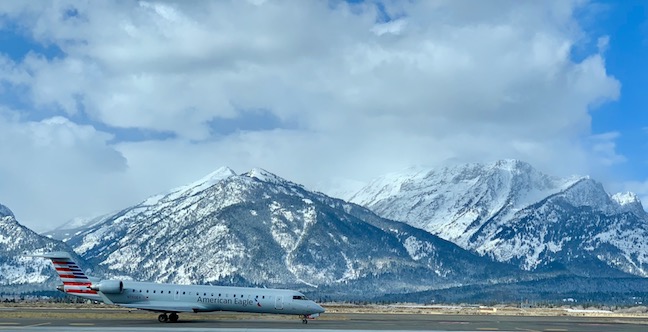
This picture reminds me of our park-friendly ways of traveling in the parks. Remember the debate over allowing automobiles in the parks in about 1914? Well, this is something much larger and noisier than a car and it is landing within the boundaries of a national park. In fact, this is said to be the only commercial airport inside any park. And like almost any other park topic, this one has its own continuing debates, such as whether to lengthen the runway.
— Another lesson I take from this image is just how vast nature can be. The plane is only a few hundred feet away and yet it is dwarfed by the mountains several miles away in the background.
— I might add, that usually when you enter a park by car you can easily drive an hour or more before you see the majestic wonders of the park, but when you fly into Jackson, wow, there are the Tetons in all their splendor, welcoming you.
A Mural on the Wall Inside the Hotel where I Stayed in Jackson
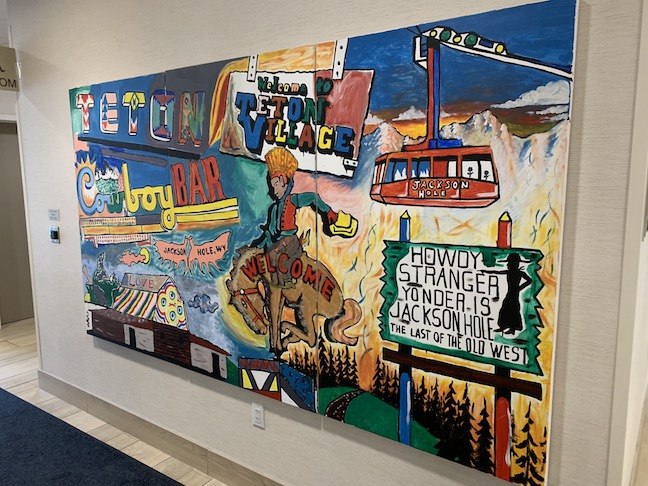
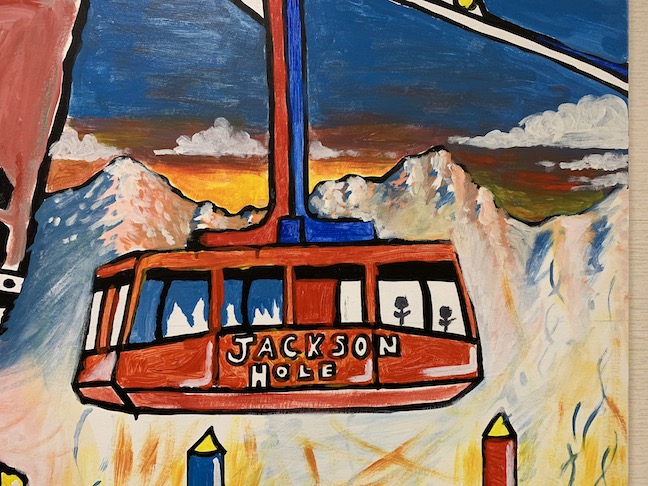
This mural reminded me of several features of the parks stories: 1) Around the bigger parks there is a National Park culture unique to each particular park. 2) This “culture” expands from the park itself to the nearby community. In this case the culture includes the recreational activities (The tramway leads to ski trails high in the mountains just outside the park.), the frontier and cowboy legacy of Jackson Hole (“the last of the Old West”). and last but hopefully not least the mountains and forests themselves.
— I think that the message of the tram car is especially suggestive: big car, overshadowing the mountain — manmade entertainment beats out contemplation of nature. Jellystone bouncing circle trumps Jellystone forest and waterfall.
Airport Iconography in Sculpture, Painting, and Artifacts
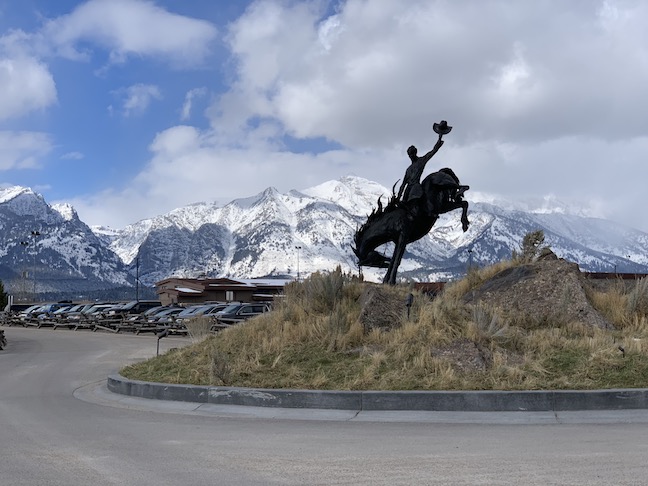
Statue on Road Leading into Airport
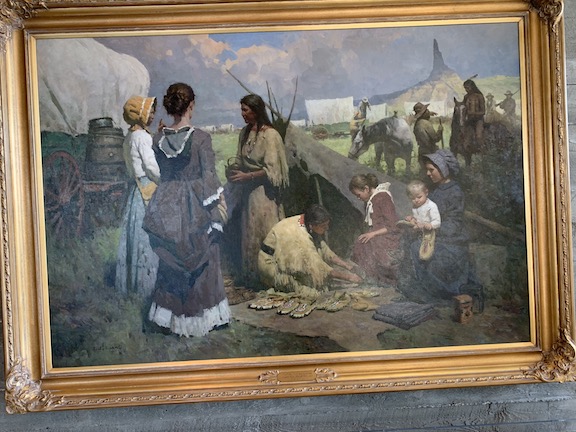
Painting Inside the Airport: Indians Selling Moccasins to Pioneer Families
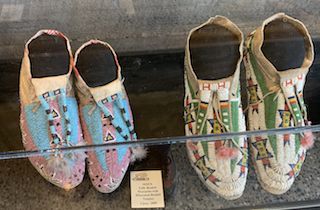
Hundred-Year-Old Moccasins Displayed Beneath the Painting
These are more examples of National Park culture inside the park. The statue says, “Hello, Stranger. The cowboy lifestyle is an important part of the Teton Past.” The painting says, here is an Indian story that I bet you didn’t know: our people traded moccasins for pioneer goods as wagon trains passed near here. The moccasins say, we are some actual historic moccasins to prove it.
— One of the criticisms of the parks is that in some cases they were unfair to the Indians, especially in prohibiting natives from using traditional hunting grounds. In many ways, such as these, the parks are bringing Native Americans back into the story.
— But wait, admittedly all of these things are part of the park story, all well and good, but what about some artistic representation of nature in the park? Well, scroll back up to that statue of the cowboy. What is in the background. Great Nature itself, right – the very thing, speaking for itself!