
Capitol Reef: Mother Nature and a Historic Orchard
Fireside Talk
October 31, 2016
J. William T. Youngs
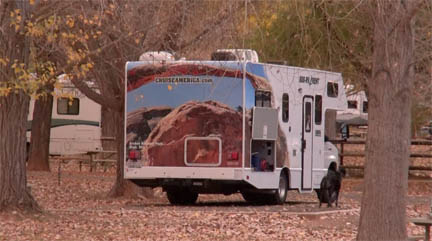
As I write this, I am sitting in an RV in a campground at Capitol Reef National Park. It is 4:30 in the morning, and I have been awake since about 3:00. I stepped outside just now and looked at the stars: Outstanding. Dark sky. Bright pinpricks of light. The stars are up there all the time, but how often do we really see them? Sometimes Mother Nature spoils the view with clouds or with moonlight. Often we ourselves are the spoilers with our air pollution and bright lights. But not here, not tonight. I got up at this to-me-ungodly hour to write a “Fireside Talk.” This talk, as a matter of fact. This challenge awaits the instructor (as in “me”) during the on-the-road portion of an online class: the exciting rush of new sights, sounds, and ideas is complicated by the accompanying elusiveness of quiet time to take it all in, arrange hundreds of photos and film clips, and bring it all together in a composition of words and images, as in, a Fireside Talk. But now, several hours before the sun breaks over the reef of rocks to the east, let me try… First, some pedagogic background: one of my objects in History 498 is to encourage and enable you to see nature in general and parks in particular through the history of the men and women who created the parks; I want us to learn their stories and also have a taste of the literature and art associated with the park venture. I want us to be able to see the various aspects of today’s parks within the framework of controversies and decisions of the past. And I hope that from time to time we can experience a kind of kinship with John Muir and Theodore Roosevelt and Stephen Mather….
Five days ago I flew from Spokane to Salt Lake City, picked up a rental RV, and met up with friends from Jackson, Wyoming, along with their two dogs. Since then we have been exploring southern Utah — arguably the most park-intense section of the United States. On this trip I’m visiting Grand Staircase-Escalante National Monument (what a name!), Capitol Reef National Park, and Canyonlands National Park.
A Word about Capitol Reef
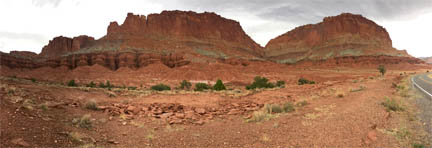
Capitol Reef at about Noon This Past Sunday
The park brochure describes Capitol Reef as a “wrinkle in the earth’s crust extending nearly 100 miles.” The brochure continues: “A vibrant palette of color spills across the landscape before you. The hues are constantly changing, altered by the play of light against the towering cliffs, massive domes, arches, bridges, and twisting canyons.” I particularly like this quotation from geologist Clarence Dutton, who explored the “reef” during the 1880s. “The light,” he said, “seems to flow or shine out of the rock rather than to be reflected from it.” (Does anyone else hear in this passage the echo of John Muir’s description of the Sierras as the “Range of Light”?) My campground is in the “Fruita Historic District” of the park, a fertile plain nestled between towering cliffs of red rock. The local “scenery” includes a schoolhouse, a blacksmith shop, and a pioneer cabin. Additionally, there are orchards in the Fruita Disctict, planted by Mormon settlers — some 3000 trees bearing apples, peaches, cherries, plums, apricots, and almonds.
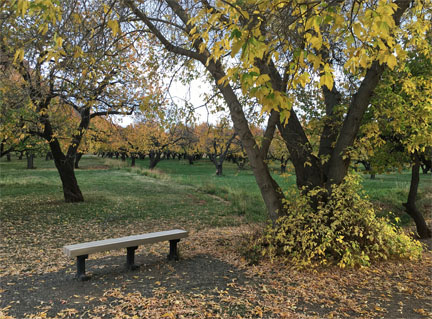
The park brochure tells us that visitors are welcome to walk through the orchard and pick fruit when in season. The season has passed, but yesterday when I walked through an orchard, it was still rich in colors.
A Word about Orchards, Parks, and the Organic Act
The outstanding feature of Capitol Reef National Park is its geology, and the signature feature of the parks as a whole is their mission of preserving landscapes. “Leave it as it is.” Theodore Roosevelt said of the Grand Canyon. “You cannot improve on it.” So what is an orchard doing in the middle of a national park? “Leave it as it is.” An orchard is nature tamed, not wild. And yet here I sit in a man-made recreational vehicle, in the middle of a campground, in the middle of an orchard, in the middle of a national park! What is going on?! Well, I think I can answer that. What is happening here provides a vivid example of the complex mission of the parks. Yes, parks are meant to preserve natural settings. BUT (1) those settings are to be made available for the “enjoyment” of all of us. And another BUT: (2) they are required to preserve historic features as well as landscapes. • As the Organic Act (1916) declares: the parks are intended “to conserve the scenery and the natural and historic objects and the wild life therein.” Each of these “BUTS” is at constant war with the fundamental park mission: preserve natural settings — preserve the wilderness. And so the park service must constantly balance preservation with access, and it must balance nature with history. Often those decisions are complicated. In Cades Cove, for example, in Great Smoky Mountains National Park, the builders decided that twentieth-century farm buildings did not belong, but nineteenth-century cabins suited the landscape just fine. It must take the wisdom of Solomon to make those “calls.” But I am glad we still have those cabins in the Smokies. And I am a big fan of Capitol Reef’s orchards. Next time I visit the reef, I will arrive a month or so earlier and feast on almonds and cherries! P.S. I don’t want to leave you with the impression that Capitol Reef is “just” fruit orchards, and so here is a picture of the rocks looming over the campground in the early morning light:
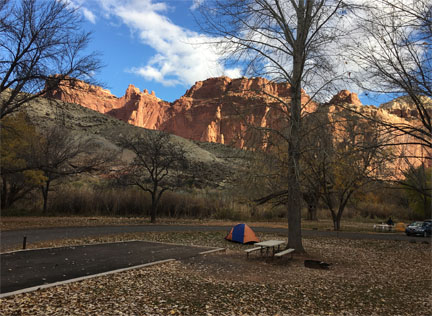
And here is a little film of one of the many rock formations in the park. This one is called the “Fluted Wall.”