A Perilous Day on Long’s Peak in Colorado, 1962
Once upon a time I was a college student, like all of you. And like you, I felt an urge to wander and explore. After finishing my junior year at Harvard I set out on my motor scooter for what turned out to be an 8000 mile crisscross trip from Cambridge, Massachusetts, to Los Angeles, California. At one stage I slept out for eight weeks in succession without a tent, covering myself in a ground sheet and sleeping bag. And yes, many times I got very very wet!
Fortunately, I had decided to keep a diary along the way. And fortunately I still have that diary 61 years later. At the time, those many years ago we had no such thing as computers and word processing software. So I wrote down my thoughts and recorded my experiences with a pencil, sitting outside at a picnic tables or simply leaning up against a tree. Now many years later I’m glad that I kept writing despite inclement weather and frequent fatigue. As I review these pages now it is somewhat like looking over the shoulder of a complete stranger, but then again I also feel at times, yes, that is me!
This fireside talk is an excerpt from that diary. It focuses on my ascent of Long’s Peak, which I learned recently is regarded as the most deadly mountain in Colorado. Along with the story of my climb, I have included sketches of various people I met during this interlude on my trip. In my mind one of the great things about camping trips is the encounters with people you meet along the way.
By the way, when I mention “Gnaw Bone” in this story, I am referring to the name I gave my Lambretta motor scooter. It is the name of a small community near Bloomington, Indiana, where I grew up.
I hope you enjoy this story of campers and climbers!
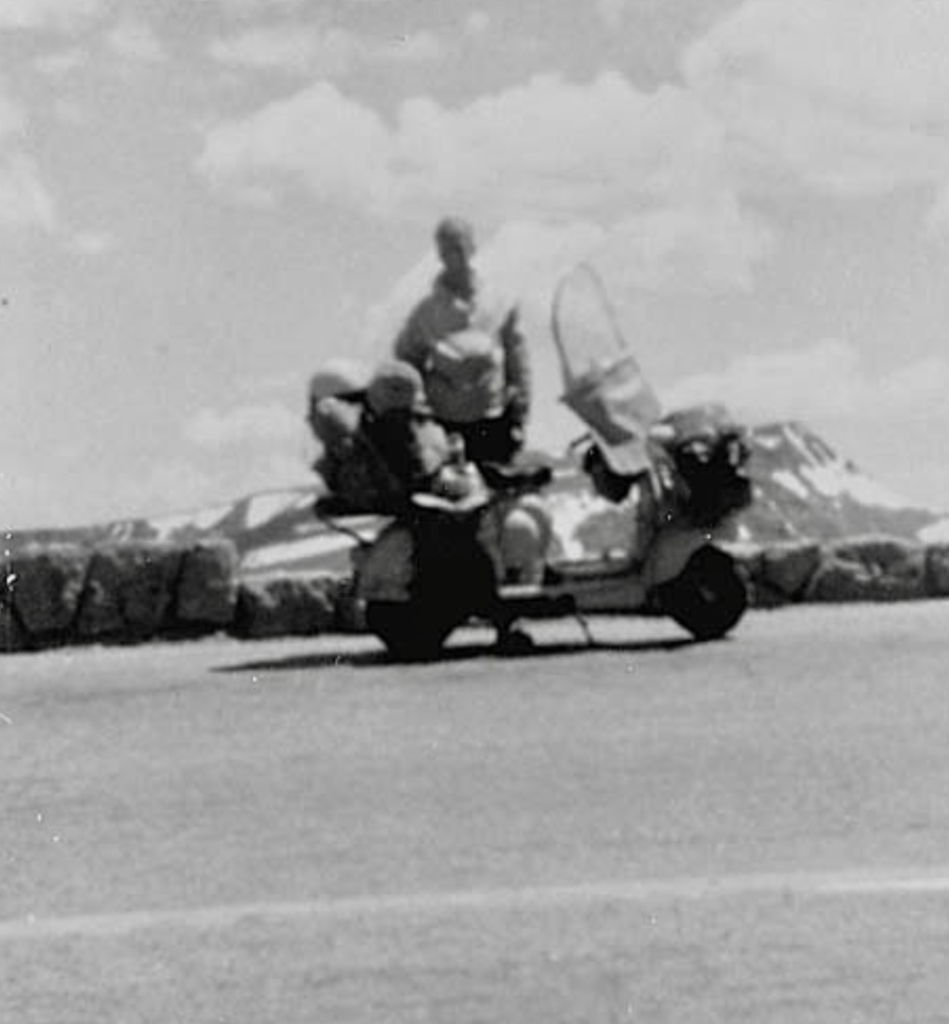
Yours truly with “Gnaw Bone” in the Colorado Rockies, 1962
From the Diary
July 20, 1962
Today I crossed Rocky Mountain Park to the Long’s Peak Campground. It can’t be much more than fifty miles, but it took me about six or seven hours.
There were a lot of good views on the Trail Ridge.
I pulled into the campground here at about 4:00. I had a couple of good cups of tea and a fine supper.
Afterwards I wrote and read for a good while. As it got cooler I curled up near my fire and let it keep me warm. It had a good glow and the night was calm and clear. In a while all the other lights in the campground went out and I had the whole evening to myself. I was on a little hill over the camp. So it was very nice.
Then I went to sleep and was fast asleep until the dawn.
[Reminiscing about the previous day….]
I forgot to mention above in its proper order of chronology and import, a fellow I met early morning in my camp. I was bent over my blue jeans sewing a patch onto the tail when I heard him come up and say “hello.” I looked up and saw a fellow with a pale face and a sporty hat set distinctively on his head.
I stood up and talked to him a bit. We began with the traditional conversation where are you going and how does the scooter do… I didn’t really put my heart into it because I was working on my trousers and a little weary of the old questions about Gnaw Bone.
But then I began to notice his hands. They were clumsy looking and perhaps withered. Yet he did not hide them, he either gestured with one or held them both half in his pockets. I noticed too that his shoulders were very thin under his shirt. This was the first indication I had of any infirmity of his, but with it I began to like him – not pityingly, but as someone who seemed pretty tough. And then, too, I noticed a fine strength in that pale face beneath that funny hat. I excused myself to go on working on the patch, but went on chatting. We talked some about great adventures we’d heard of. He told me about a book he’d read about a man and his wife who hiked right across Mexico. He had a great admiration for those who truly roughed it.
He and a friend were traveling in a station wagon and sleeping in the back. He was very interested in seeing some of the old Indian villages around Taos, and had read an article about an old woman on one of the Pueblos – Maria Hernandez – whose work was supposed to be fine. He had also read Death Comes For The Archbishop and liked it very much. He hoped to be able to see Acoma, but was worried about his wheelchair. He also asked me whether he’d be able to see any of the ruins in Mesa Verde in the chair. He talked about his infirmity – which was polio – very naturally and openly.
That was about all there was to the conversation. But that guy left me with a good feeling all the day. It was only when I saw him walk, hobbling slowly and awkwardly away from the fire that I realized how badly the disease had struck his body. I have wished since meeting him that when we were talking about the various exploits of several world travelers I had said what I feel – that he has more real guts than the bunch of them!
{Back to the Long’s Peak campground….]
July 21, 1962
Today I spent almost entirely around the campground, I awoke with the dawn and after a little debate I decided to get up and try to do some exercise. I ran some but couldn’t find a place really to cut loose. Then I did some pushups and came back for breakfast.
Next I spent most of the morning reading at Grapes of Wrath. In the early afternoon I went into Estes Park to do some laundry and get some food.
In the evening I got pretty well involved in puttering around and the long break from my book broke the pattern there.
At one point a fellow came over and asked me about the scooter and whether I was going up Mount Long. I wasn’t too responsive and felt badly about it later.
But I met him again in the restroom and we had a good talk going. He told me he was driving a tractor in Western Kansas for the summer. And so I asked him about the size of the farms and the position of the small farmer. We talked about this for a while and I ventured to tell him I was curious because a book I was reading – Grapes of Wrath – was concerned with the destruction of the small farmers in Oklahoma.
My introduction of a book into the conversation wasn’t lost time, because I eventually discovered that he is studying at Depaul and wants to be a minister. He is just now beginning to study Kierkegaard and Tillich. So we too stood in the lamp light outside the restroom and talked about religion and Tillich and Kierkegaard! The outcome of such an euridite conversation was that I decided to climb Long’s Peak with him and his brother tomorrow!
July 22, 1962
Today Bill and Dick Murray [these new friends] and I walked up Long’s Peak – well I can really say “climbed” here justly because a lot of it was climbing. We set out at about 6:30 and made good time up to the so-called “boulder field;” here high up in the mountains is a broad plain full of boulders. On it the going got pretty tough as we couldn’t walk at a good solid pace but had to run up and down the boulders.
I began to get pretty winded too – especially when we got up to about 13,000 feet and could look over a sheer cliff face at a valley and a lake far below, and the same cliff continuing up the mountain far above. I felt a little sick in my stomach a couple of times, and a little giddy in the head, but it passed.
From this resting point on the cliff face Bill Murray tossed a stone down the wall; it fell fine for a long time seeming to arch inward towards the cliff as it fell. Then it struck a rock far below and rebounded for another long plunge. Finally when it hit the bottom we were all a little touched by the fall. I think a small part of each of us had gone with it on that breathtaking plunge.
After this stop we set out again up the mountain. It was only about a half a mile to the top. But it was a very steep half mile up cables and across snow fields; and each strenuous movement made you giddy for awhile afterwards.
Finally the boulders stopped reaching upward and we were on a broad, level peak at 14,255 feet above sea level.
There was quite a view all around. But, I didn’t really appreciate the view or the achievement because I was so tired, and because the many gnats attracted by the garbage of careless climbers made it hard to concentrate on the view. But we all felt pretty good about being there and about having made the climb.
Down the other side, we followed another trail. This one was less steep than “The Cables.” Most of the time you had to lower yourself with arms and feet and it got awfully tiring.
Some ways off the peak we heard someone shouting from above. Dick called back and circled further down the ledge we were on to try to locate the caller.
It turned out to be a man who had gotten stuck high up on the rocks above. Dick who was the best climber of us, and a pretty fit marine set out to try to help the man down.
In the meantime Bill and I dozed for a few uneasy moments of sleep. I had no sympathy for the man supposing he had gone off half cocked, knowing nothing and had gotten himself into his fix by carelessness.
In about a half an hour Dick had helped him most of the way down the cliff. We could hear him saying in a babying tone, “Come on now, Mark. It’s not far now.” I thought the man must really be psyched out. But then I saw a third, tiny, body and then a fourth, and I realized that the man had two children with him.
It turned out that they had set out down the mountain, but had been misled as to where the trail was. The way looked reasonable at first, but became harder until finally it had become a real cliff where he and his sons were stuck. They’d had to lower themselves over several drops. So they couldn’t get back up.
I guess he was pretty shaken when Dick reached him. The children had been crying, and as the man lowered them to Dick; his own hands shook badly. But with this help over the worst spot and with someone who knew a way back down, they got to us without much trouble.
From there on the father and two children and we three went on down together. The youngsters were eleven and nine. Both of them were a little big eyed and scared from the descent. But both were really pretty brave about it and were really game all down the mountain to the boulder field and across that tiresome stretch. When we were well out of it, we three set out ahead again, and moved on down. After the boulders the trail wasn’t bad. I was tired in the legs during the last of the sixteen mile trip. But I felt pretty good about it all. Soon after I got back here my legs and stomach felt – and feel just fine.
Dick and Bill headed down to Denver for the night. So I’ve already said goodbye to those two friends. But about 15 minutes after I got back to camp the father and two children arrived in camp. Those kids put in one Hell of a day’s work. He asked me over to supper with his family, and I was glad to accept.
Even after seeing them off the bad section I had felt a little unsympathetic with the father – had thought maybe he’d just foolishly tread a tough way. But I grew a lot more sympathetic to him during supper. He had just made a mistake and an understandable one.
He was honest about the extent of his fear before we’d arrived. I can’t quite get at it, but I now feel pretty good about the man and his kids who got stuck on a cliffside, and about the family that gave me dinner. [end of journal entry]
Looking back on Long’s peak
In 2012 I made an effort to retrace portions of my 1962 cross country journey. This time instead of traveling on a humble motor scooter I drove a midsized Winnebago towing a trailer in which I carried my Spyder motorcycle. While camping in New Mexico I made an acquaintance with the man from Colorado who told me he had climbed most of the 14,000 foot peaks in his state. As I recall, there are about 40. I asked him about Long’s Peak, and he told me that he considered it too dangerous and was not going to try it. I was astonished because even though I am not a climber by any stretch of the imagination, I had gone up and back in the course of a day.
I have been wondering since then how I had gotten up Long’s Peak if it was so dangerous, and even more I wondered how the man with the two children had gotten up. Well, they might have gotten lost before actually reaching the top. But that still leaves the question of how those two fellows from Kansas and I climbed this apparently dangerous mountain. Perhaps some routes were simply more dangerous than others, but you may recall that we stood on one ledge where we could throw a rock down the chasm about 2000 feet deep.
At any rate, I am looking at a mystery where I am a key figure in the story. I wish that I had pictures taken on the mountain that day to help me recover the route, but this was long before the age of digital photography and lightweight cell phone cameras. All I had was an old Kodak box camera, and during the entire Summer I only took about two rolls of film. Remember, I was then a college student, and I was doing my best to save money!
What follows is a few items of research on the peak and a couple of contemporary photographs. I may never know exactly what route I took that day, but these items are pieces of the puzzle.
- Here is a news item published about one month after my own adventure on Pikes Peak: “Kem Arnold Murphy, a 19 year old student fell to his death, from a trail near the summit of Longs Peak on August 27, 1962.”
- Good historical article on Longs PeakLinks to an external site. — also includes information about the Keyhole route with advice to climbers today.
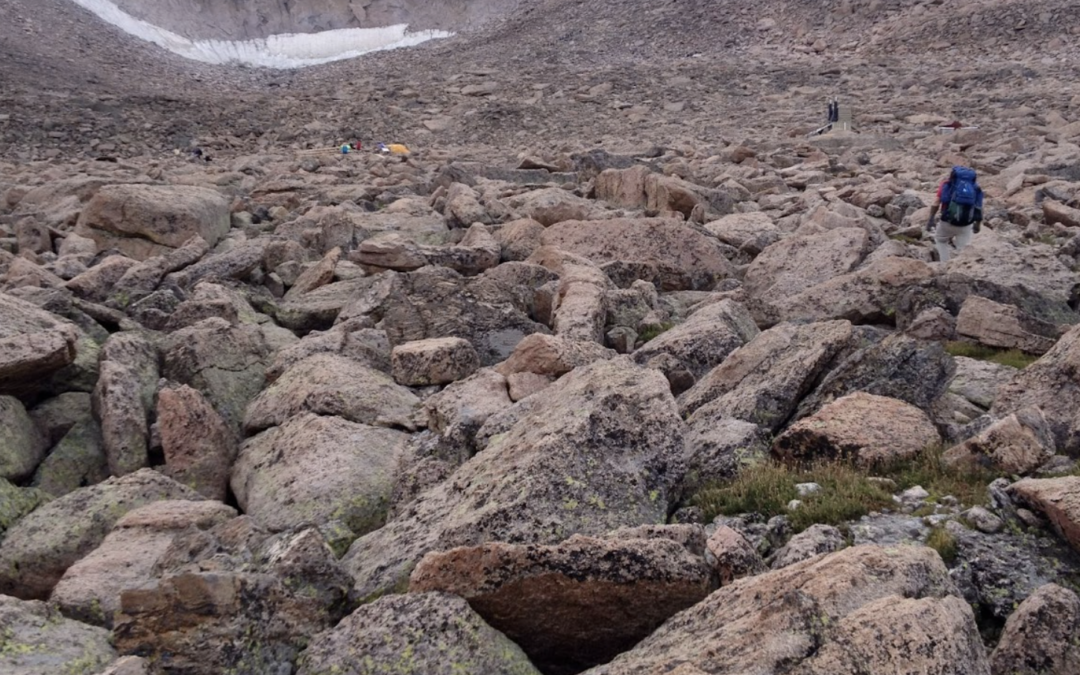
This is a picture of the boulder field we crossed on the way up.
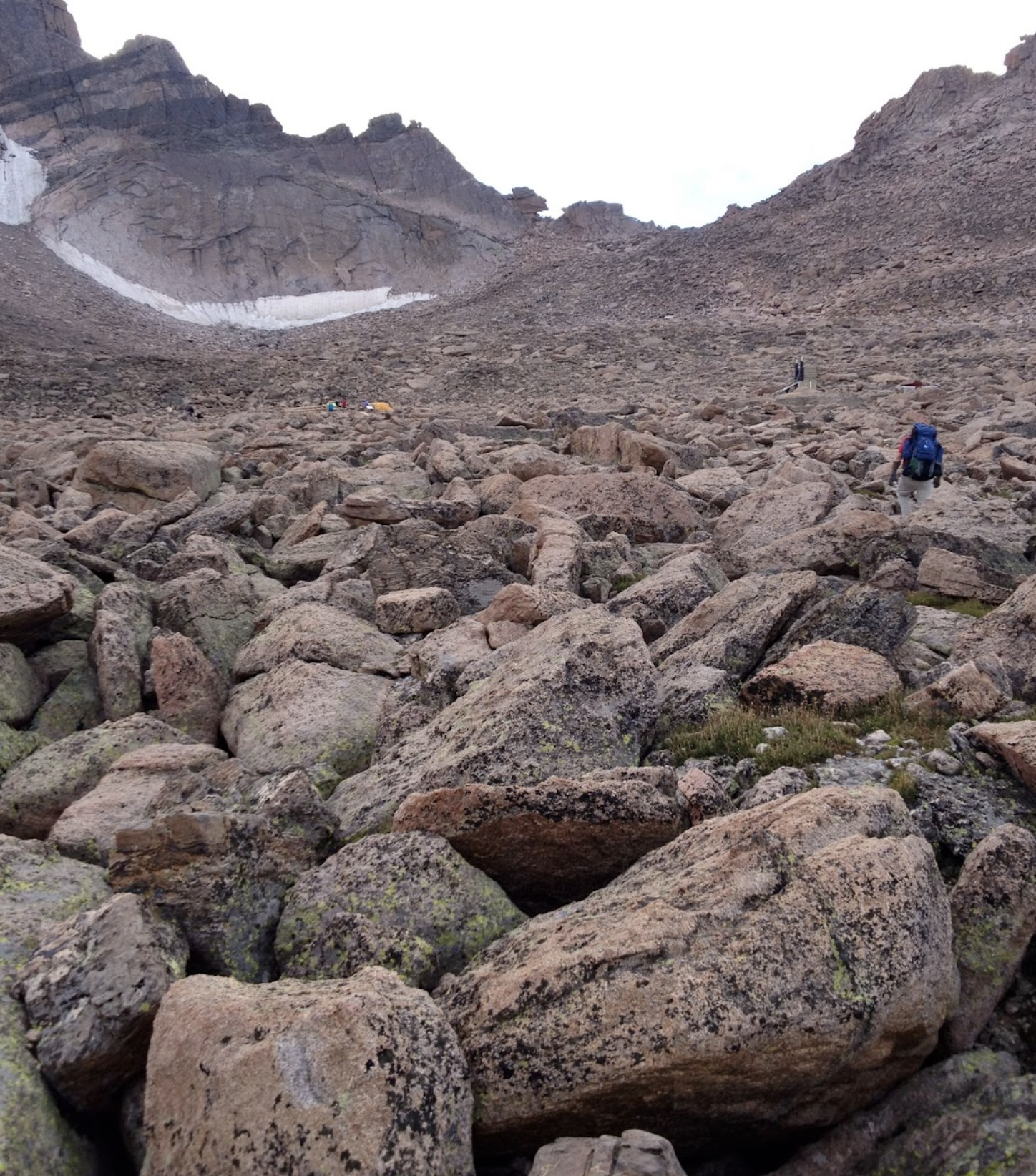
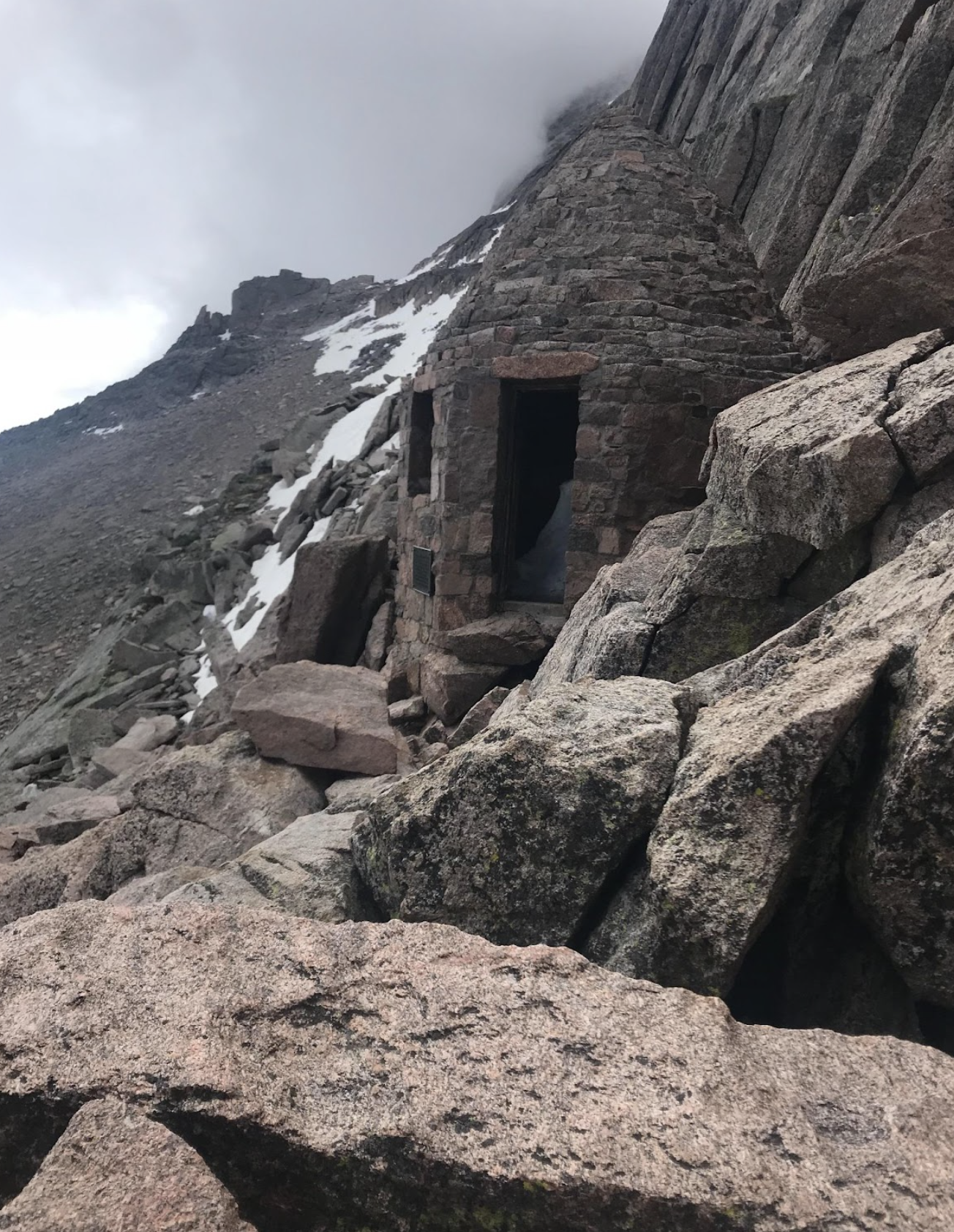
Here is the Agnes Vaille Shelter (In 1925 she became the first woman to climb Longs Peak in the Winter, but she died during the descent.)
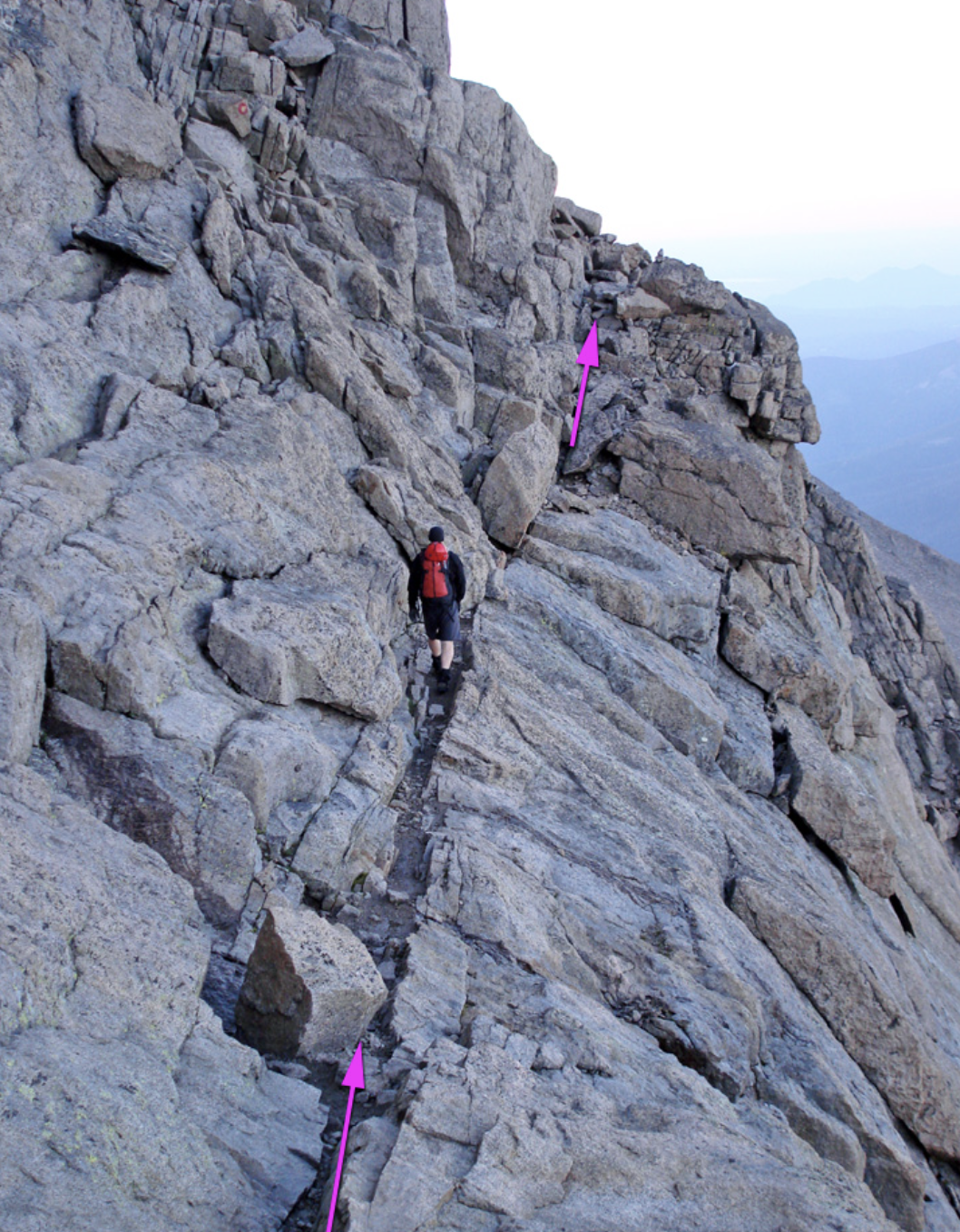
This MAY be the route we took on the way up. I’m not sure, but it scares me just to look at it now!