
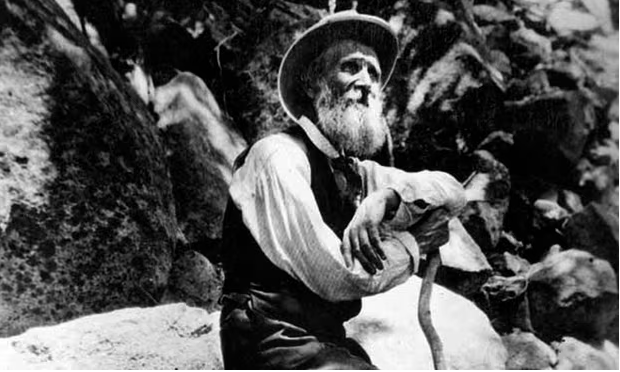
OK, listen up!
“I care to live only to entice people to ____________________________.”
Complete this statement.
If you say “look at Nature’s loveliness,” you are quoting John Muir correctly.
But if you say, “show the superiority of the White race,” believe it or not, you are echoing a 2021 statement by Michael Brune, then-president of the Sierra Club.
I am exaggerating, but only slightly.
The statement shocked many Muir fans and many Muir scholars (including myself) — who it turns out, know John Muir’s history much better than Michael Brune.
They immediately wrote articles condemning this ill-informed nonsense. But unfortunately, the story had some of the effects of the classic trigger, “when did you stop beating your wife?” Never happened, but….
Alas, this contemptible accusation has found its way to dozens of journals including the Washington Post, which ran this headline:
“Sierra Club Apologizes for John Muir’s Racist Views”
Notice that the Post did not say, “Alleged Racist Views” or “Supposed Racist Views” or my favorite, “Non-Existent Racist Views.”
I’m writing this post because sometime, somewhere you may hear some well-meaning person say, “John Muir? He is controversial, isn’t he?”
I heard that statement a few days ago from a good friend and devoted naturalist and hiker. The experience led to my writing this Fireside talk and the prompted the.asperity of my tone. (Oh, you noticed!)
Well, some folks still claim that the earth is flat. Does that make the roundness of the earth “controversial” — merely a theory?!
If you said “no,” go to the head of the class.
By the same token, to anyone who has studied the sources, the notion that John Muir is a racist is just plain wrong — and harmfully wrong.
And in case any one of you should run into anyone in the future who takes seriously the John Muir “controversy,” I want you to be able to introduce some truth-telling into the discourse.
And so herewith, several “truth arrows” for your intellectual quiver:
A. Think of your reading in John Muir’s Travels in Alaska — what does it tell us about his relationship to Indians?
B.. LInk to an article in the Earth Island Journal titled “Who was John Muir, Really?” written by Aaron Mair, Chad Hanson, and Mary Ann Nelson — all current or former members of the Sierra Club Board. I’ve copied here a key passage in that article. To see the entire article, click here.
“It’s important to think critically about our movement’s historical figures, John Muir included. However, some recent articles by environmentalists and environmental writers — though perhaps guided by good intentions, and well-written and researched in other respects — contain some inaccurate and unfounded information that could create damaging divisions among the conservation movement and environmental justice advocates. We aim to set the record straight.”
C. Brief article by Raymond Barnett with helpful links to other related articles.
John Muir a Racist?!
Scholars, Sierra Club Leaders refute charge
( You can also view this article online at www.raymondbarnett.com/blog/posts/37785 )
“A lie can travel halfway around the world while the truth is still putting on its shoes”-Mark Twain
On July 22, 2020, Sierra Club Executive Director Michael Brune stunned the club by unilaterally publishing a manifesto (“Pulling Down our Monuments”) accusing founder John Muir of being a racist and the Sierra Club of being complicit ever since in defending and furthering systemic racism in American and the Sierra Club itself.
Within hours, a chain of emails began which linked 40 or so Sierra Club members, former officers, and academic scholars who were familiar with Muir’s life and writings. Prominent among the themes recurring in these emails was the obvious ignorance of Executive Director Brune regarding John Muir.
The first email in the chain was from former Sierra Club national president Richard Cellarius, who promptly emailed Brune that very day: “Before you further continue the cleansing of John Muir from the Sierra Club…please read and reflect on the essay by Raymond Barnett, ‘John Muir: Racist or Admirer of Native Americans?‘ ”
That essay carefully and at length considers Muir’s life and writings, and concludes that “John Muir was not a racist, but to the contrary an admirer and staunch defender of North America’s Native Americans, all the while honestly portraying the terrible burden they endured during their Sierra Nevada holocaust, and its affect upon them. Isolated instances in his journals or private letters when he occasionally expresses distaste for the appearances or manner of the holocaust-scarred Sierra Nevada Native Americans cannot be taken out of the much broader context of his many expressions of admiration of the Sierra Nevada and Alaska tribes; his touching enthusiasm for Alaska’s Native American life, especially; his insistence that Native Americans were fully human “brothers”; and his heated in-the-face defense of California’s Native Americans to a U.S. Army Colonel involved in extirpating them.”
The preeminent Muir biographer, Dr. Donald Worster, soon published an article coming to the same conclusion: “Muir has been dead for more than a century, but if he could speak from the grave, I can easily imagine him agreeing that systemic racism is bad and should be repudiated, for he never published a word in support of black slavery, racial segregation, the Confederacy, forced sterilization of minorities, or genocidal policies toward Native Americans.”
And the former President of The Sierra Club Foundation, civil-rights attorney Guy T. Saperstein, also corrected Brune’s mis-characterization of Muir in a widely-circulated July 29 email to Brune: “I applaud your efforts to make the Sierra Club more inclusive and to reflect the diversity of America…But I am appalled at the hatchet-job attack by you and the Sierra Club Board on John Muir’s legacy. Muir may have made ill-considered comments about Native Americans and blacks as a young man, but he became enlightened about both races after living with black families on his walks in the South and living with Native Americans in Alaska. How many of his era were even open to living with different races? He decried the unfair treatment of blacks, and he expressed understanding and appreciation for Native Americans, while denouncing how whites had abused them with alcohol…Rather than the low-life racist you and the Board portray him as, Muir was high in the ranks of enlightened men of his time. Your attack is political correctness run amuck.”
Dr. W.R. Swagerty, Director of the John Muir Center at the University of the Pacific, was also dismayed by Brune’s actions. In a widely-circulated October 27 email, he said “I am so disappointed in the Sierra Club’s leadership on this…Just as we are seeing so many wonderful children and young adult illustrated books on Muir make their way into the hands of students in elementary schools and junior highs…Sierra Club officers have decided to undermine that effort…May the Club survive, but may the leadership change.”
As Muir scholar Lee Stetson (better known for three decades of live portrayal performances of Muir) has put it, “To attribute racist comments to Muir…You’d have to disregard his entire lifetime of considered thoughts and good deeds, and to turn your back on any kind of historical perspective. It’s unjust and stupid, but you could do it.”
The ignorance and injustice of Brune’s mis-representation of Muir outraged leaders of the British hiking community as well; quickly Rucksacks Readers founder Jacquetta Megarry published an article entitled “Should the Sierra Club Apologize for John Muir?” “My answer to the question in the title is a resounding NO! The anachronistic self-flagellation of the club’s present leaders does nothing to serve its long-term goals. They are displaying considerable ignorance of their founder member’s early life, his nuanced writings, and above all of the attitudes prevalent when he lived. They have been seduced by the modern fad for rewriting history, preferably combined with some statue-toppling and feet of clay.”
Even some members of the Sierra Club’s Board of Directors were upset by Brune’s wrong-headed portrayal of Muir. From Board member Chad Hanson’s essay “Who Was John Muir, Really?”: “This is the John Muir who is worthy of honor and respect—the Muir who evolved beyond his upbringing and worked to protect Nature while simultaneously promoting admiration for Native American culture and speaking against racist government policies…As we join together to create a more inclusive and just environmental movement, and to bring about needed societal transformations to increase environmental protections, racial equality and social justice, defining people by the trajectory of their lives, rather than by the worst or lowest versions of themselves across the history of their experience, is going to be important. Why? Because we are going to need people to evolve, to become better, if we’re going to succeed. John Muir’s evolution as a person can serve as an example of this.”
In view of these thoughtful statements from a multinational group of Muir scholars, outdoors people, and Sierra Club members, officers, and former officers, it seems clearly hasty and ill-advised to expunge Muir’s name from any school, park, trail, or glacier. All those quoted here agree that systemic racism exists in American society and should be corrected. But they also agree that, based on full consideration of John Muir’s life and writings, “cancelling” John Muir’s name is not warranted, and in fact nonsensical. Certainly, for example, the name “John Muir Elementary School” should be proudly maintained.
Links to complete essays, articles referenced above (between 5 and 15 minutes each):
Worster article: https://www.californiasun.co/stories/john-muir-biographer-he-was-no-white-supremacist/ (Distinguished historian Worster’s A Passion for Nature: the life of John Muir is the preeminent modern biography of Muir’s life)
Megarry article: https://www.rucsacs.com/should-the-sierra-club-apologise-for-john-muir/ (Megarry is the founder of Rucksack Readers, a successful publisher of trail-handy guides to hiking paths in Scotland, Ireland, and England. See also her essay Four Fallacies to Avoid in Evaluating Historical Figures: http://www.raymondbarnett.com/blog/posts/38068 )
Hanson essay: https://johnmuirproject.org/2020/07/who-was-john-muir-really/ (Pacific Crest Trail veteran Hanson founded the John Muir Project and is a Sierra Club Board member)
Barnett essay: http://www.raymondbarnett.com/blog/posts/37037 (Retired Biology professor at Calif. State Univ., Chico, Barnett has authored essays and a book on Muir)
— Note this is a longer version of the article by Raymond Barnett, copied above.
3. Raymond Barnett also published the following article in his blog. It addressed the larger issue to truth-telling in historical writing. (I like it so much that I plan to assign it in my future classes on writing!)
Guest blog by Edinburgh, UK editor and publisher Jacquetta Megarry; see note at end. January 26, 2021
From Raymond Barnett’s blog Living and Writing in the Natural World
Michael Brune’s 22 July 2020 manifesto accusing John Muir of racism embodies four dangerous fallacies. They are not unique to the Sierra Club. Indeed, in the wake of the George Floyd’s brutal death in Minneapolis in May 2020, worldwide reactions have included statue-toppling, cancelling of distinguished names and reputations, and attempts to rewrite history. The proposal to take John Muir’s name off an elementary school named in his honour in San Francisco and elsewhere should be seen in this context of over-reaction to a tragic event that took place over a century after Muir’s death in 1914. The proposal rests on four fallacies, which must be avoided:
1. Don’t rely on a few words quoted out of context: evaluate the man’s whole life.
Brune’s attack relies on a few negative phrases quoted from the young Muir’s unedited and unpublished journals. He ignores Muir’s many other positive comments and, throughout his long life, his campaigns and travels. Later he travelled and spent time living with Native Americans, and commended their stewardship of the environment.
2. Never find somebody guilty by association.
Brune criticises John Muir for his friendship with “people like Henry Fairfield Osborn, who worked for both the conservation of nature and the conservation of the white race”. Muir respected Osborn’s work as a zoologist and paleontologist. Osborn’s role in founding the American Eugenics Society, though, was years after Muir’s death. Muir had a very wide circle of friends and colleagues; nobody is responsible for opinions other than their own.
3. Don’t attribute prejudice to a person for words that became pejorative long after his death.
Fashions in language evolve over time. Words such as “negro” were at first purely descriptive, only later acquiring racist overtones. According to the Jim Crow Museum, until “black power” was coined in 1966, “negro” was how most back Americans described themselves. From the late 1980s, Jesse Jackson promoted the term African-American. Nowadays in some countries it’s common to refer to people as black, in others as BME or BAME (black, asian and minority ethnic), BIPOC (black, indigenous, people of colour), and in others simply as people of colour. Before too long, any or all of these may become unacceptable as new words are adopted as “correct”.
4. Beware of anachronistic judgement and woke rewriting of history.
Muir lived at a time when unthinking racism was the norm, and yet he challenged it by his words, deeds and campaigns. His radical thinking and pioneering conservation should be celebrated, not grotesquely rewritten by people who have barely studied him.
–Jacquetta Megarry is the founder of Rucksack Readers, a successful publisher of trail-handy guides to hiking paths in Ireland, England, and Scotland–including The John Muir Trail there.
D, Some quotations from the definitive biography of John Muir: Donald Worster, A Passion for Nature (2011) — throughout his book Worster describes examples of John Muir’s positive relationships with and comments about Native Americans. Here are several examples.
“The Indians put us to shame…” (in The Thousand Mile Walk)
We have been out of bread a few days, and begin to miss it more than seems reasonable, for we have plenty of meat and sugar and tea. Strange we should feel food-poor in so rich a wilderness. The Indians put us to shame, so do the squirrels,—starchy roots and seeds and bark in abundance, yet the failure of the meal sack disturbs our bodily balance, and threatens our best enjoyments.
Muir, John. John Muir: Nature Writings (LOA #92) (Library of America) (p. 195). Library of America. Kindle Edition.
“They are your very brothers.” (in Alaska)
That call for a new moral inclusiveness was not limited to plants and animals; Muir worried also about the fate of the indigenous peoples of Alaska and Siberia, whether they had already sunk into a debased dependency or were struggling to keep their economic freedom. He had discovered much in the “so-called savages” to admire: the quiet, competent dignity of Toyatte; the tears of a wife telling her husband good-bye; the laughing eyes of children raised without fear in a hard land; the shrewd negotiations of native traders who met the whites on equal terms.
As he moved farther away from the frontier settlements, where whites and natives lived intermingled, the natives became more and more attractive in their moral character. Inupiats, he decided, “are better behaved than white men, not half so greedy, shameless, or dishonest.” Acknowledging how little he had come to know them in his travels, he was nonetheless strongly drawn to them: “These people interest me greatly, and it is worth coming far to know them, however slightly. . . . There was a response in their eyes which made you feel that they are your very brothers.”
Worster, Donald. A Passion for Nature: The Life of John Muir (pp. 273-274). Oxford University Press. Kindle Edition.
Nursing a Sick Child (in Alaska)
His friend the Rev. Young recalled a moment in their travels when Muir’s empathy for the native Alaskans kept him up all night, nursing a sick child. Following their first excursion into Glacier Bay, they paid a visit to the Chilcat village of Yindestukki, whose chief man was Donnawuk. Worn out after much travel and tribal oratory, the explorers could not sleep because of the feeble whimpering of a very small baby whose mother had died. No nursing mothers in the village could provide any milk for the infant, and he was dying of starvation. Muir brought a can of milk from their canoe, diluted it with warm water, and began an all-night vigil of feeding and care. He bathed the child and walked with him in his arms for five or six hours, until he fell asleep. The next day they left their whole supply of canned milk with the chief’s household, with instructions on feeding. Donnawuk was so moved that he offered to give the baby, if he survived, to Muir. Seven years later Young returned to the village and found that the baby had lived and grown into a healthy boy, whom he [Donnawuk] named John.
Worster, Donald. A Passion for Nature: The Life of John Muir (pp. 274-275). Oxford University Press. Kindle Edition.
E. On the value of heroes. In discussion posts, your classmate made a valuable comment about the importance of folks like Leopold and Marshall for the environmental movement going forward. Is this true of John Muir as well?!
Keegan Breneman writes, it “stands to reason that wilderness preservationists must also know their own people’s stories, their own hero figures, in order to nurture that tradition into the future.”